Beauty Ecommerce Just Outgrew the Store by 6x. Here's What's Driving It.
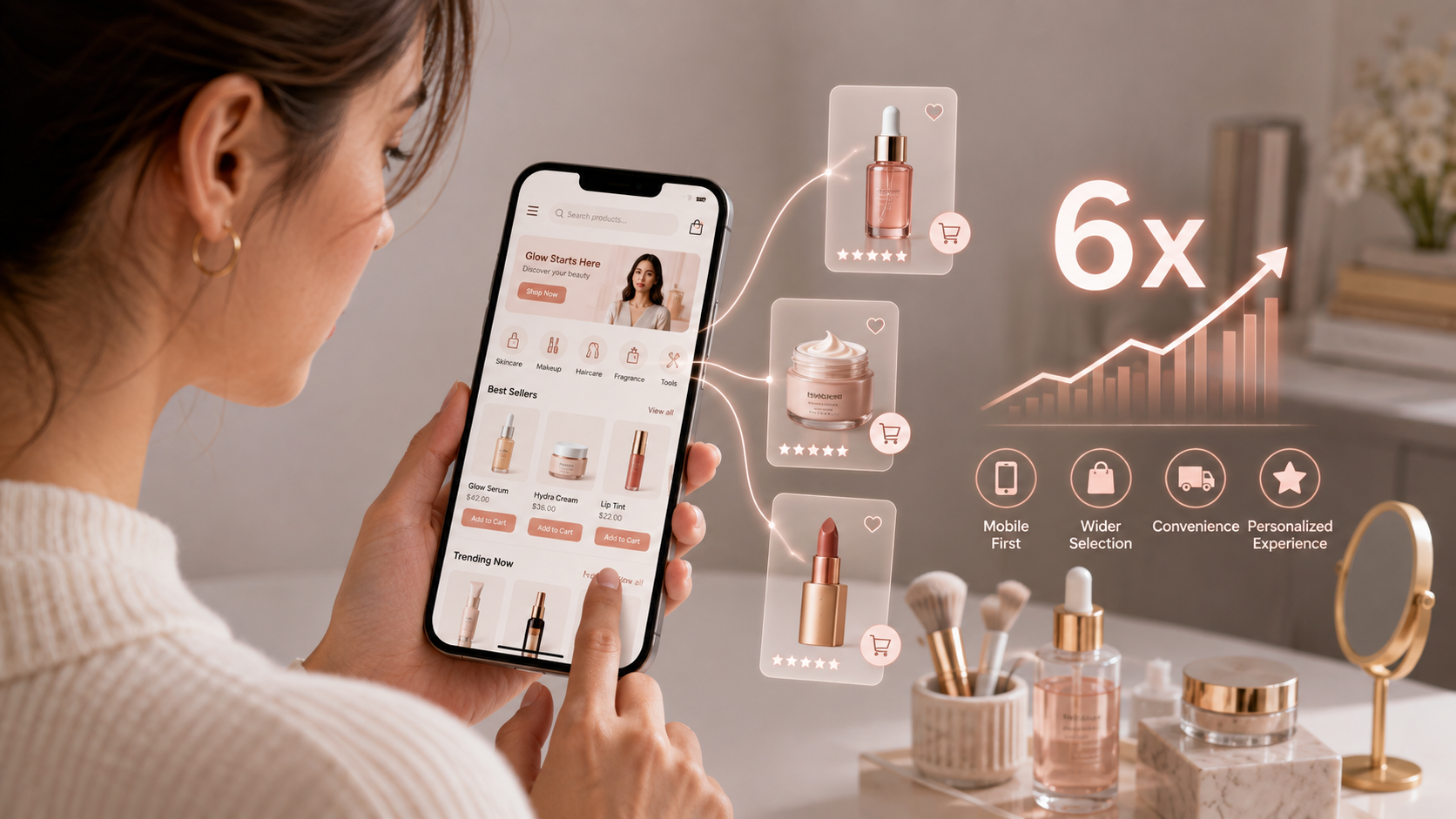

The global beauty market grew 10% year over year, and ecommerce is now expanding six times faster than brick-and-mortar sales, according to NielsenIQ's newly released State of Beauty 2026 report.
That's not a marginal shift. It's a reordering of where beauty actually gets bought.
The report, built on point-of-sale data across nine categories in 52 markets, points to something bigger than a channel shift. Beauty is becoming a digitally-discovered category, and the brands winning right now are the ones showing up clearly at the moment a consumer is deciding what to buy.
A few forces are driving this:
- Nearly half of beauty consumers now receive product recommendations from generative AI
- Consumers are paying a premium for convenience and time-saving routines
- Ingredient transparency and efficacy claims are under more scrutiny than ever
- Discovery is shifting from shelf browsing to AI-assisted and social-led search
Current Beauty Consumer Trends
1. Generative AI Has Become a Beauty Advisor
Roughly half of beauty consumers already receive product recommendations from generative AI, and that number is climbing.
This isn't a novelty. It's replacing part of the function a beauty counter associate or a product page used to serve. Consumers are asking AI tools what will work for their skin type, their concerns, their routine, and expecting a specific answer, not a list of ten options.
For brands, this raises the bar on how clearly a product's use case is communicated, both to the shopper and to the AI system doing the recommending.
2. Convenience Now Commands a Premium
More than half of consumers globally say they'll pay more for products that simplify their routine.
That's pushing multifunctional and hybrid formats into the mainstream. It also means product education has to work harder in less time. A shopper who wants a simpler routine doesn't want to read five paragraphs to understand if a product fits into it.
3. Trust Is Now a Purchase Driver, Not a Brand Value
Consumers are paying premiums for locally made products and for ingredient transparency. Vague claims are losing ground to specific, provable ones.
This raises the stakes for how a product's story gets told. Generic marketing language doesn't hold up when consumers are actively cross-checking claims.
Industry Trends Impacting the Beauty Market
1. The Product Page Is Competing With the AI Answer
When a consumer can get a direct product recommendation from an AI assistant, the product page is no longer the first, or only, place the decision gets made.
That changes what the product page needs to do. It has to confirm the decision quickly, not introduce it from scratch.
2. Discovery Has Moved Off the Shelf and Into Content
Beauty shoppers are increasingly discovering products through short-form content, live formats, and AI-assisted search rather than in-store browsing or static category pages.
This is a discovery problem as much as a conversion problem, and it means brands need a consistent presence across more digital surfaces than a single ecommerce storefront.
3. Video Is Becoming the Fastest Way to Prove a Claim
Static before-and-after photos and ingredient lists only go so far when consumer skepticism is this high. Video lets a brand demonstrate a texture, an application, or a real result in a way a bullet point can't.
This is where AI-generated video starts to matter at scale. Producing a demo video for every shade, skin type, or use case used to be a resourcing problem. AI-assisted video generation makes it possible to produce that volume of proof without a full production cycle for every SKU, and to pair it with shoppable video so the proof and the purchase happen in the same moment.
Challenges and Opportunities in Beauty
The opportunity here is real: a market growing this fast, with ecommerce this far ahead of physical retail, rewards brands that show up clearly and consistently across digital discovery points.
The challenge is that most beauty ecommerce experiences still aren't built for how consumers are actually shopping now. Product pages built for browsing don't hold up well against an AI assistant that already gave the shopper an answer before they arrived.
Strategic Recommendations for Beauty Brands and Retailers
The first priority is making product use cases explicit and specific, not just for shoppers but for the AI systems now recommending products on their behalf.
The second is treating video as core infrastructure, not a marketing extra. In a market this skeptical of claims, seeing is what closes the gap that reading can't.
The third is building consistency across every discovery surface a beauty shopper actually uses, from the product page to social to AI-assisted search, rather than treating them as separate channels.
Looking Ahead
Beauty didn't just move online faster than expected. It moved into a mode of discovery that rewards proof over persuasion.
The brands that treat video and AI-assisted content as the way they answer a shopper's question, not just as a way to advertise, are the ones positioned to capture this growth.
Want to turn product claims into proof shoppers can see? See how leading beauty brands are using AI-generated video to close the gap between discovery and purchase.
FAQ
Why is beauty ecommerce growing faster than in-store sales in 2026?
NielsenIQ's State of Beauty 2026 report found ecommerce growing six times faster than brick-and-mortar, driven by AI-assisted product discovery, social commerce, and consumers prioritizing convenience over routine in-store shopping.
How is AI changing the way consumers shop for beauty products?
Nearly half of beauty consumers now receive product recommendations directly from generative AI tools. This shifts part of the decision-making process away from browsing a website and toward a direct, specific answer, which raises the importance of clear, well-structured product information.
Why does video matter more for beauty brands right now?
Consumer skepticism toward vague claims is rising, and video lets brands demonstrate real results, textures, and applications rather than describing them. It's a faster way to build the trust that's now driving purchase decisions.
What should beauty brands prioritize given these trends?
Clear, specific product use cases; video content that proves claims rather than just stating them; and a consistent brand presence across product pages, social platforms, and AI-assisted search.
Unlock Exclusive Insights
By submitting this form, you agree to Firework's privacy policy and consent to receive personalized marketing communications. You can unsubscribe at any time.