Home Appliances Industry Trends: What’s Shaping Shopping in 2026

The home appliances industry is no longer just about features and specs. Today’s shoppers want clarity, visual context, and confidence before they hit “Add to Cart”, especially as appliances become smarter, more connected, and more expensive.
From AI-generated product demos to video-first discovery, from guided commerce to seamless cross-channel experiences, retailers and brands are reinventing how appliances are presented, discovered, and purchased online. Here’s a deep dive into the major trends transforming the home appliances category in 2026 and what they mean for retailers.
1. Shoppers Demand Context Over Specs
Gone are the days when a long list of specifications was enough to persuade. The modern appliance shopper wants to know:
- How will this fridge fit into my kitchen?
- What’s the real difference between this washer and the next?
- How do smart features actually work in everyday life?
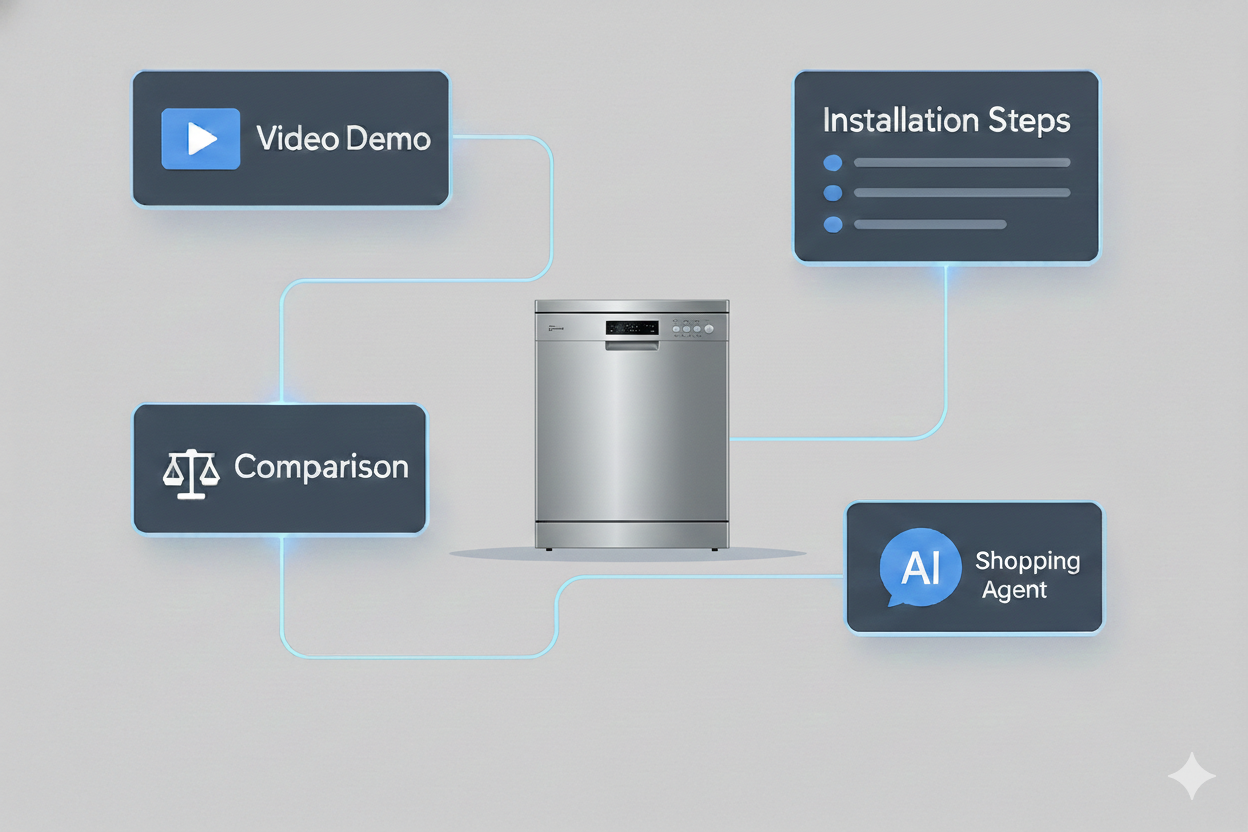
Video commerce has become the go-to format for answering these questions. Short product demos, installation walkthroughs, and lifestyle context videos help shoppers see outcomes, not just technical data.
Research shows that video content increases shopper confidence, often boosting conversion rates by up to 40% compared with static content alone. Rather than leaving shoppers to interpret specs, immersive video lets retailers show, not tell.
2. AI-Generated Videos Are Filling the Content Gap at Scale
One of the big problem areas in home appliances ecommerce is the sheer number of SKUs, variations, configurations, finishes, and installation styles multiply fast, and traditional video production can’t keep up.
This is where AI-generated video has shifted from novelty to necessity. Instead of generating a single hero video for a core SKU, retailers can now:
- Create explainer videos for every major configuration
- Generate comparison videos that show one product versus another
- Localize videos by market without costly reshoots
- Update videos dynamically based on new features or shopper patterns
AI-generated video fills the gaps where traditional content falls short, ensuring every product gets the visual proof shoppers need without massive production timelines.
3. Guided Commerce Combines Video and AI to Reduce Uncertainty
Home appliances are inherently complex: installation requirements, connected features, energy ratings, and size constraints all factor into buying decisions. Shoppers want to feel confident in their purchase decisions, and if they don’t get the answers they need, they’ll click off.
This is why AI shopping assistants and guided experiences are gaining traction: instead of forcing shoppers to scroll, read, or search, these tools:
- Interpret the shopper’s need (e.g., “washer for a family of four”)
- Surface the most relevant content
- Present short videos that address that need directly
- Deliver comparisons and recommendations within the journey
Agentic commerce (where AI acts as an active guide) is helping retailers surface the right visuals and explanations at the right moment, turning hesitation into clarity.
4. Shoppable Video Is Becoming Part of the Buying Flow
In traditional ecommerce, video often sits at the bottom of the PDP or in a carousel no one clicks on. But 2026 is different. Retailers are embedding shoppable video experiences that allow shoppers to:
- Receive product education through video content and explore variants or features
- Add products to cart directly from a video
- Receive personalized recommendations
This turns video from education into execution, enabling a smoother path to purchase.
5. Connected Appliances Demand Connected Content
Modern appliances are more part of broader connected ecosystems:
- Smart ovens that sync with voice assistants
- Refrigerators that show grocery lists on your phone
- Washers that notify your smartwatch when cycles are done
Shoppers evaluating connected products need content that demonstrates integration, not just features. This drives three key content needs:
- Use-case videos showing real everyday scenarios
- Interactive product tutorials that highlight smart features
- AI prompts that answer context-specific queries (e.g., “How do I pair this with HomeKit?”)
Brands that deliver this level of contextual explanation unlock confidence, and reduce return rates driven by unmet expectations.
6. Mobile Shopping Is Dominant, and Experience Must Follow
Even for high-ticket categories like appliances, mobile interaction is pivotal. Mobile ecommerce traffic continues to grow, and shoppers increasingly use phones for:
- Researching products
- Watching video demonstrations
- Comparing options
- Completing purchases
However, simply porting desktop content to mobile isn’t enough. Retailers must rethink how:
- Videos play and render on smaller screens
- Navigation flows from inspiration to purchase
- AI guidance appears contextually within a mobile journey
Experience continuity across devices, where mobile starts and desktop finishes, is now table stakes in omnichannel appliance retail.
7. Omnichannel Isn’t Just a Buzzword, It’s a Shopper Expectation
A significant portion of appliance shoppers still interact with physical stores at some point, whether for installation guidance, in-store pickup, or showroom inspection.
But the expectation now is a connected, omnichannel experience:
- See a product on mobile
- Compare it to alternatives on desktop
- Watch installation videos at home
- Book delivery or installation in store
Retailers that treat each touchpoint as an isolated experience risk losing shoppers to competitors who treat it as a single connected journey. Omnichannel isn’t just about presence, it’s about coherence.
Retailers that offer transparent, video-based content around sustainability choices help shoppers make values-aligned decisions, and build brand trust in the process.
8. Personalization Isn’t Enough, Contextualization Is the New Frontier
Personalized recommendations still matter, but alone they don’t close the content gap. What also matters is contextualization, showing the right explanation for the right shopper at the right time.
That means:
- Serving videos that address a specific concern
- Surfacing comparisons dynamically
- Using AI to shift content based on intent signals
- Guiding the experience rather than relying on catalogs
When retailers leverage personalization and contextual AI insights, they move beyond relevance into resonance, the place where conversion actually happens.
Where Appliance Retail Is Headed
- Video-First Discovery Will Sweep the Funnel
Not just on PDPs, but in search, recommendations, and comparison tools. - AI Runs Guided Experiences, Not Just Product Recommendations
Moving from static lists to adaptive journeys. - Shoppable Video Will Become a Conversion Engine, Not a Bonus Feature
Embedded directly into product, comparison, and support screens. - Post-Purchase Engagement Will Shift to Explanation and Activation
Helping shoppers use what they bought, not just sell them more. - Content Gaps Will Be Seen as Revenue Leaks, Not Creative Challenges
And retailers will invest accordingly.
Final Thoughts
Home appliances aren’t bought with impulse. They’re bought with confidence. The retailers winning in 2026 are the ones who replace uncertainty with clarity, not with text and price tags, but with video, guidance, and context at every step of the journey.
Explore how contextual video, guided experiences, and AI-powered content can help you close the content gaps on your appliance PDPs and increase conversion across your ecommerce funnel.
FAQ
Why is video especially important for home appliances?
Appliances are complex purchases. Video demonstrates use, installation, fit, and smart features far more effectively than static images or text.
What is AI-generated video and how does it scale?
AI-generated video uses generative models to produce product demonstrations, comparisons, and explainers at scale without traditional production timelines.
Can shoppable video really increase conversion?
Yes, by reducing steps between understanding and buying, shoppable video turns moments of clarity directly into purchase actions.
Does guided commerce work on mobile?
Absolutely. Modern guided experiences are designed to be responsive and context-aware across devices, especially mobile.
Is this approach only for enterprise brands?
No. AI-generated and video-centric content systems make guided, context-rich experiences accessible even for mid-market retailers.
Unlock Exclusive Insights
By submitting this form, you agree to Firework's privacy policy and consent to receive personalized marketing communications. You can unsubscribe at any time.