How AI Is Transforming Home Appliance Ecommerce


How AI Is Transforming Complex Purchase Decisions Into Guided Experiences
Buying a home appliance has never been simple, but in today’s ecommerce environment, it has become significantly more complex.
Unlike lower-consideration categories, appliance shoppers are navigating detailed specifications, comparing models, and trying to understand how a product fits into their home and daily routines. They are not just choosing a product, they are evaluating long-term value. Questions around size, compatibility, performance, and efficiency shape the decision, yet most digital experiences still rely on static product pages that were not designed to support this level of complexity.
As a result, shoppers frequently leave the product page to find answers elsewhere. They open multiple tabs, read reviews on third-party sites, and compare options across retailers. This introduces friction at the most critical moment in the journey, where confidence determines conversion.
This is where agentic commerce introduces a different model.
The Limits of Traditional Product Pages
The traditional product detail page was built to display information, not to guide decisions. While it presents specifications, images, and reviews, it assumes the shopper will interpret everything independently.
In a category like home appliances, that assumption breaks down. The volume of information can overwhelm rather than assist. Even well-structured PDPs often fail to answer contextual questions like whether a refrigerator fits a specific kitchen layout or whether a washing machine meets a household’s usage needs.
This gap between information and decision is where most ecommerce experiences lose momentum.
From Static Information to Guided Decision-Making
Agentic commerce shifts the role of the product page from a passive information hub to an active decision environment.
Instead of requiring shoppers to search and interpret, AI introduces real-time, contextual guidance directly within the experience. The model moves away from asking, “What do you want to know?” and toward proactively surfacing what matters most for the shopper’s decision.
This shift is particularly impactful in appliance shopping, where decisions are rarely straightforward and often require multiple layers of validation.
How Leading Retailers Are Moving Toward Agentic Experiences
This shift is already happening across major home improvement and appliance retailers.
For example, Lowe's has introduced Mylow, an AI-powered assistant designed to help customers navigate complex home improvement decisions. Rather than simply searching for products, shoppers can describe their project and receive step-by-step guidance, recommendations, and relevant product suggestions in real time.
While not fully agentic at the product page level, it reflects a clear shift toward guided, conversational experiences that connect project intent directly to product discovery and purchase.
Similarly, The Home Depot has introduced Magic Apron, a generative AI assistant designed to bring the expertise of in-store associates into the digital experience. Embedded across millions of product pages and within its app, Magic Apron helps shoppers answer product and project questions, summarize reviews, and receive step-by-step guidance in real time.
Rather than simply supporting search, the experience is designed to guide customers through complex decisions, replicating the role of a knowledgeable associate and helping shoppers move from research to action with greater confidence.
What these examples signal is a broader shift. Retailers are recognizing that shoppers do not just need access to information, they need help interpreting it.
What This Looks Like on a Modern Appliance Product Page
On a modern appliance product page, the experience becomes more interactive and supportive.
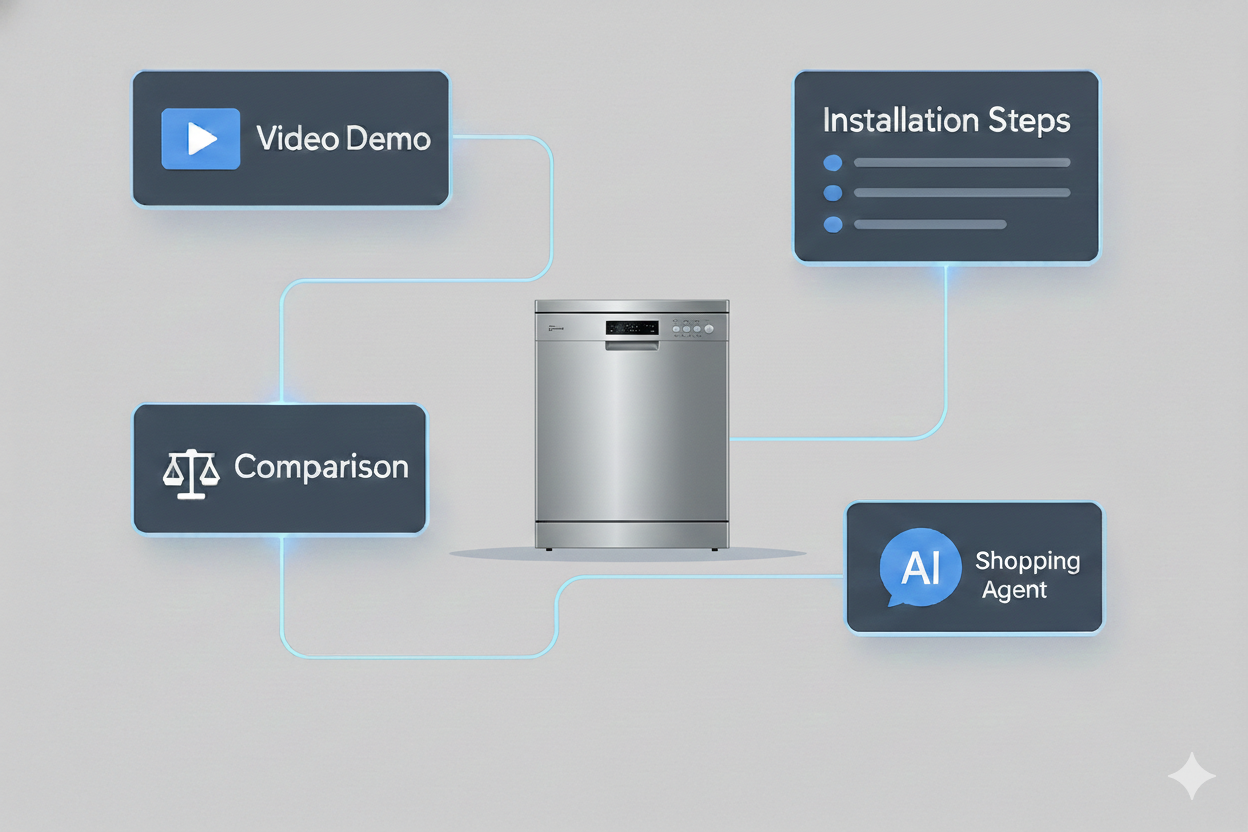
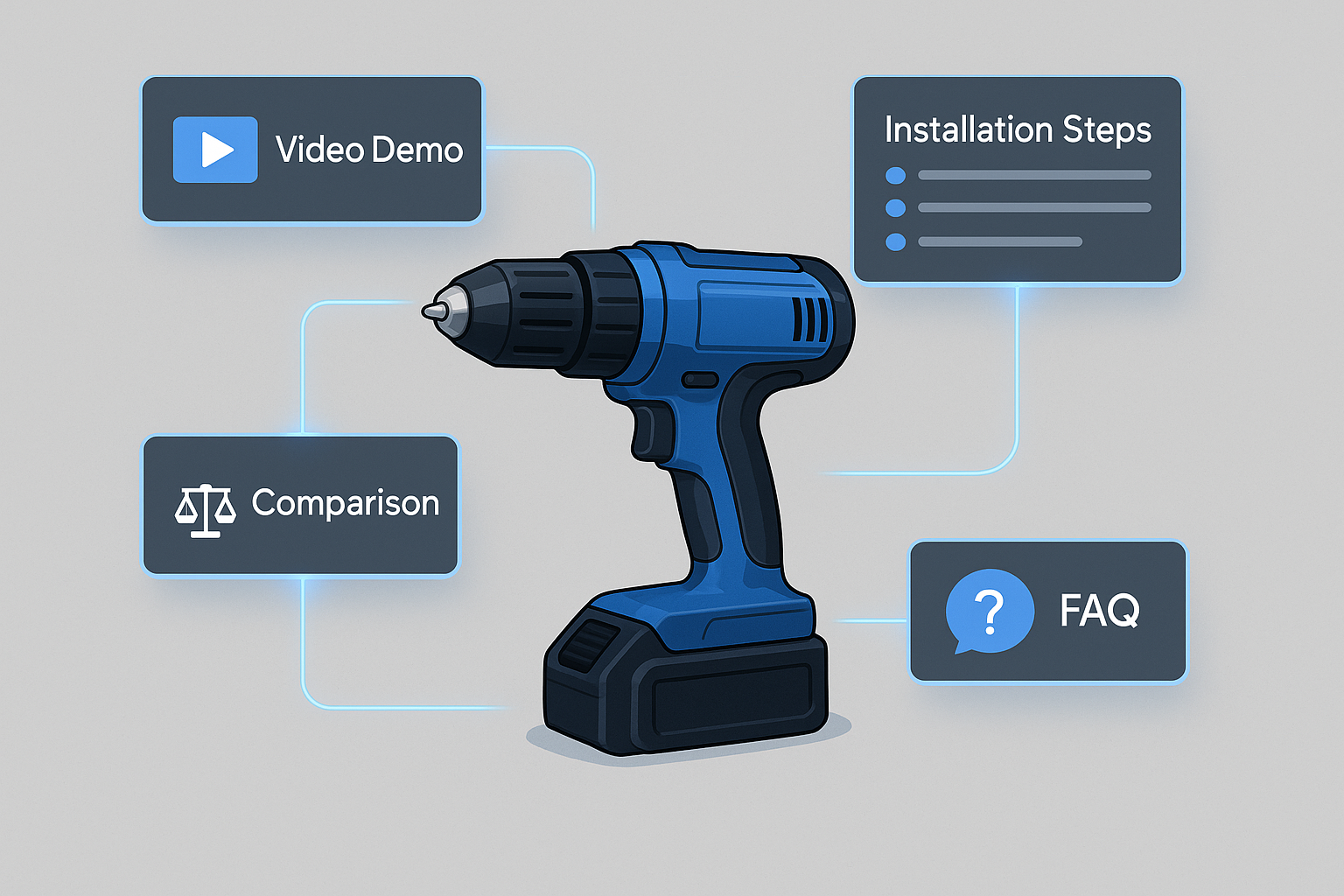
Video plays a key role in helping shoppers understand the product beyond static imagery. Instead of relying on specifications alone, shoppers can see how a refrigerator is organized, how a washing machine operates, or how a dishwasher fits into a real kitchen environment. This type of visual context reduces uncertainty and accelerates decision-making.
Shoppable Video enables this by embedding video directly into the product page, allowing shoppers to engage with content in a way that mirrors in-store exploration.
At the same time, AI-powered guidance replaces static FAQ sections with conversational interactions. Shoppers can ask questions naturally and receive immediate, contextual answers without leaving the page.
With solutions like AI Shopping Agent, the experience becomes more than reactive. It begins to anticipate shopper needs by surfacing relevant comparisons, highlighting key features, and recommending complementary products based on context.
This transforms the product page into a guided decision environment rather than a static endpoint.
Why This Matters for Appliance Brands
For appliance brands and retailers, this shift has direct implications for performance.
When shoppers receive the information they need in context, they are more likely to move forward with confidence. This reduces hesitation and improves conversion rates. It also reduces reliance on external research, keeping shoppers within the brand’s ecosystem.
Better-informed shoppers are also less likely to return products. In a category where returns are costly and operationally complex, improving decision confidence upfront has a measurable impact.
There is also a clear opportunity to increase average order value. Guided experiences make it easier to introduce relevant add-ons such as installation services, accessories, or warranties in a way that feels helpful rather than disruptive.
Why Home Appliances Are the Ideal Use Case
Home appliances are uniquely suited for agentic commerce.
The combination of technical complexity, higher price points, and context-dependent decision-making makes it difficult for traditional ecommerce experiences to perform effectively. Shoppers need more than information. They need clarity.
This is where guided experiences deliver the most value. By combining video, AI, and contextual recommendations, brands can bridge the gap between understanding and action.
The Evolution of the Product Page
The role of the product page is changing.
It is no longer just a place to display product information. It is becoming the primary environment where shoppers evaluate options, ask questions, and make decisions.
Agentic commerce transforms the product page into a dynamic experience that functions as a product expert, a comparison tool, and a sales associate all in one.
This evolution reflects a broader shift toward more intelligent, connected commerce experiences where content and guidance work together to support the shopper journey.
Closing Thought
Home appliance shopping has always been complex. What is changing is how that complexity is handled. Agentic commerce makes that possible by turning product pages into guided experiences that help shoppers move from uncertainty to confidence, faster.
Turn Product Pages Into Guided Shopping Experiences
See how AI-powered product guidance and video-driven experiences help appliance brands improve conversion and reduce return rates.
Unlock Exclusive Insights
By submitting this form, you agree to Firework's privacy policy and consent to receive personalized marketing communications. You can unsubscribe at any time.