AI Commerce vs DTC: Where Ecommerce Conversion Actually Happens


There is a version of the future that gets told a lot in ecommerce circles right now: AI agents will replace the brand website. Shoppers will type a query into ChatGPT, get a recommendation, and check out without ever landing on a product page. The DTC site becomes a warehouse backend. The brand becomes a SKU in someone else's interface.
It is a compelling story. It is also not what the data shows.
What Actually Happened When Brands Tested It
Walmart is one of the largest retailers on the planet, with the budget and infrastructure to run any experiment it wants. In late 2025, it tested 200,000 products directly inside ChatGPT, giving shoppers the ability to discover and purchase without leaving the AI interface. The result: conversion rates inside ChatGPT were three times lower than when users clicked through to Walmart's own site. Walmart is now building its own integrated AI shopping experience instead.
Shopify ran a similar test, integrating its checkout with ChatGPT. It terminated the program for the same reason: conversion did not hold up outside the owned environment.
These are not small pilots from brands hedging their bets. These are the largest retailers in the world putting real traffic and real inventory against the thesis that AI platforms can replace the owned site as a conversion surface. The thesis failed.
Discovery and Purchase Are Different Behaviors
The confusion in the "DTC is dying" narrative comes from conflating two distinct things: where shoppers find products and where they buy them.
Discovery has always been distributed. Shoppers find products on Instagram, TikTok, through influencers, in search results, from friends, and now increasingly through AI tools. That is not new. Brands have always needed to be visible across multiple surfaces to capture attention early in the journey.
But purchase is different. Purchase requires trust, context, and confidence. A shopper deciding whether to spend $180 on a skincare serum, $600 on a kitchen appliance, or $95 on a pair of boots wants to understand what she is actually buying. She wants to see the product in use. She wants her questions answered. She wants to know the return policy. She wants to feel like the brand stands behind what it is selling.
Social media traffic converts at roughly 1.2% on average across platforms. Direct traffic to brand sites converts at 3.8%. That gap is not a coincidence. It reflects the difference between a shopper in discovery mode and a shopper in purchase mode. The owned site is where the latter lives.
The Shopper Who Arrives from AI Is More Valuable, Not Less
Here is the part of the agentic commerce story that gets missed: when a shopper does click through from a ChatGPT recommendation or a TikTok video to a brand's DTC site, she arrives with more context and higher intent than a cold organic visitor.
She has already done research. She has already compared options. She has a specific question or a near-final decision. The job of the DTC site at that moment is not to reintroduce the brand or educate her from scratch. The job is to close the gap between intent and purchase.
US DTC ecommerce hit $212.9 billion in 2025, growing 16.6% year over year. Returning customers, who convert at 60 to 70% compared to 5 to 20% for new visitors, account for roughly 60% of that revenue. The owned site is where those relationships are built and where that repeat behavior lives. No third-party AI platform can replicate that.
What This Means for the PDP
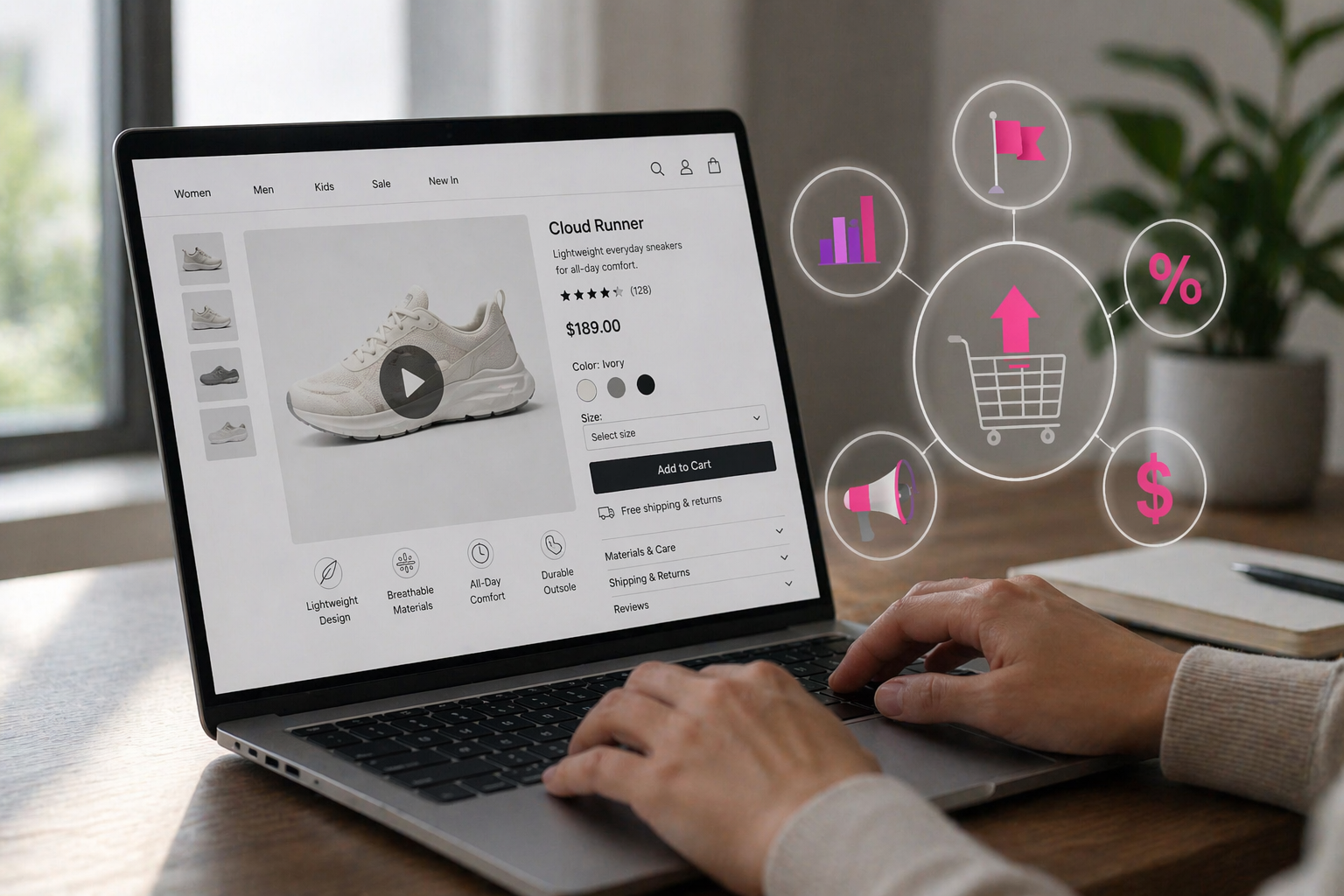
If the DTC site is where purchase happens, and if the shoppers arriving from AI and social are higher intent than average, then the product detail page is the most important surface in commerce right now. Not the homepage. Not the campaign landing page. The PDP.
And most PDPs are not built for the shopper who arrives in 2026. They are built for the browser-era shopper: someone starting from zero, willing to scroll through static images and a bullet list of features, and patient enough to hunt down the answer to a question that the page does not proactively address.
The shopper arriving from a ChatGPT recommendation or a TikTok haul video is not that person. She has a specific question. She wants to know if the foundation shade works for her undertone, whether the vacuum is compatible with hardwood floors, or how the sizing runs for someone between two sizes. If the PDP cannot answer that question in the moment she asks it, she leaves. The sale that was nearly closed goes unfinished.
The average add-to-cart rate across Shopify stores is 7.23%. Stores with add-to-cart rates above 10% consistently convert above 3.8%. The difference between those two groups is almost entirely explained by how well the product page reduces uncertainty at the point of decision.
The Role of AI Is On the Owned Site, Not Instead of It
The brands getting this right are not choosing between AI commerce and DTC commerce. They are building AI into the DTC experience so the owned site can do what third-party platforms cannot: answer questions specific to the brand's products, surface the right video content at the right moment, guide the shopper toward the right SKU, and convert the intent that the discovery channel created.
An AI shopping agent on a PDP does not compete with ChatGPT or TikTok. It completes the journey those platforms start. When a shopper arrives on a product page having been sent there by an AI recommendation, the worst possible experience is a static page that cannot answer a follow-up question. The best possible experience is a page that continues the conversation, meets her where she is in the decision process, and removes the last reason not to buy.
That is conversation commerce. Not a replacement for the DTC site. The upgrade to it.
That number understates the compounding effect: higher conversion on the owned site means more first-party data, which means better personalization, which means higher repeat purchase rates, which is where the real LTV gets built.
The Brands That Will Lose This Decade
The brands most at risk are the ones interpreting the rise of AI commerce as a signal to invest in third-party distribution at the expense of the owned experience. They are optimizing their product feeds for ChatGPT while leaving PDPs that cannot answer basic questions. They are building TikTok Shop storefronts while their brand site converts at 1.4%.
Discovery without conversion is just awareness spent with no return. The DTC site is still where that return is captured. The only question is whether the page is built to earn it.
See how brands are turning PDPs into conversion engines with AI Shopping Agent .
Talk to a Firework expert about building a video-first DTC experience.
FAQ
Is DTC ecommerce still growing in 2026? Yes. US DTC ecommerce reached $212.9 billion in 2025, a 16.6% increase year over year, and the global DTC market is projected to hit $319.57 billion in 2026. Growth is accelerating, not declining, even as social commerce and AI shopping tools expand.
Why do DTC sites convert better than social commerce platforms? Owned brand sites convert at 3.8% for direct traffic versus roughly 1.2% for social media traffic. The gap reflects shopper intent and trust. Shoppers on a brand site have made an active choice to engage with that brand. Shoppers on social platforms are in discovery mode, not purchase mode, which structurally limits conversion.
What is conversation commerce and how does it apply to DTC? Conversation commerce refers to shopping experiences where the product page or digital storefront can respond to a shopper's specific questions in real time, rather than presenting static information. For DTC brands, this means deploying AI shopping agents on PDPs that can answer product questions, guide SKU selection, and address objections before they become exits.
How does AI shopping change what DTC brands need to do? AI tools like ChatGPT and Google's Gemini are becoming discovery surfaces, sending higher-intent shoppers to brand sites with more specific questions and less patience for generic product pages. DTC brands need PDPs that can meet that shopper in the moment: answering questions, surfacing relevant video content, and completing the purchase journey that AI discovery started.
What is the most important page on a DTC site for conversion? The product detail page. It is where purchase decisions are made or abandoned. Brands investing in traffic acquisition but not in PDP quality are generating intent they cannot capture. Improving add-to-cart rates on high-traffic PDPs has a faster and larger impact on revenue than most top-of-funnel investments.
Unlock Exclusive Insights
By submitting this form, you agree to Firework's privacy policy and consent to receive personalized marketing communications. You can unsubscribe at any time.