Why Tariffs Mean Brands Must Fix Conversion, Not Just Cut Costs

The playbook most brands are running right now is defensive. Audit the supply chain. Diversify sourcing. Raise prices selectively. Absorb what you can and pass on what you can't. It is rational. It is also incomplete.
Around 71% of fashion executives are planning to increase prices in the next year, according to McKinsey's State of Fashion 2026 report. 83% of consumers say they want clarity from brands on what is driving price increases. The operational response to tariffs is necessary. But it does not solve the underlying commercial problem: when prices go up and consumer confidence softens, the brands that survive are the ones converting a higher percentage of the traffic they already have. Not the ones spending more to acquire new traffic they can no longer afford to convert at the old rate.
The margin conversation and the conversion conversation are the same conversation. Most brands only have one of them.
The Margin Math Has Changed
The US imports 89% of apparel and leather products sold in the country, leaving the apparel sector as one of the most impacted by tariffs. The downstream effects are not abstract. Victoria's Secret reported approximately $100 million in net tariff impact in 2025. Tapestry, consisting of Coach, Kate Spade, and Stuart Weitzman, reported a total expected impact on profitability from tariffs at around $160 million, representing nearly 230 basis points of margin headwinds.
Electronics and accessories face stacked Section 301 and reciprocal tariffs pushing total duties above 150%. Beauty is not immune either. Beauty companies are experiencing some of the sharpest tariff impacts, with holiday packaging relying on glass, aluminum, or specialty plastics becoming particularly vulnerable to tariff-driven price increases.
The instinct in this environment is to cut spending. Marketing budgets compress. Acquisition spend gets throttled. The traffic drops. And if conversion rates stay the same, revenue drops with it.
The brands that are navigating this most effectively are doing something different. They are treating existing traffic as an asset, not a given. The shopper who arrives on a product page today is more expensive to acquire than she was two years ago, more price-conscious than she was six months ago, and more likely to compare before committing. The question is whether the page she lands on closes the sale or loses it.
When Prices Rise, Value Has to Show Up Faster
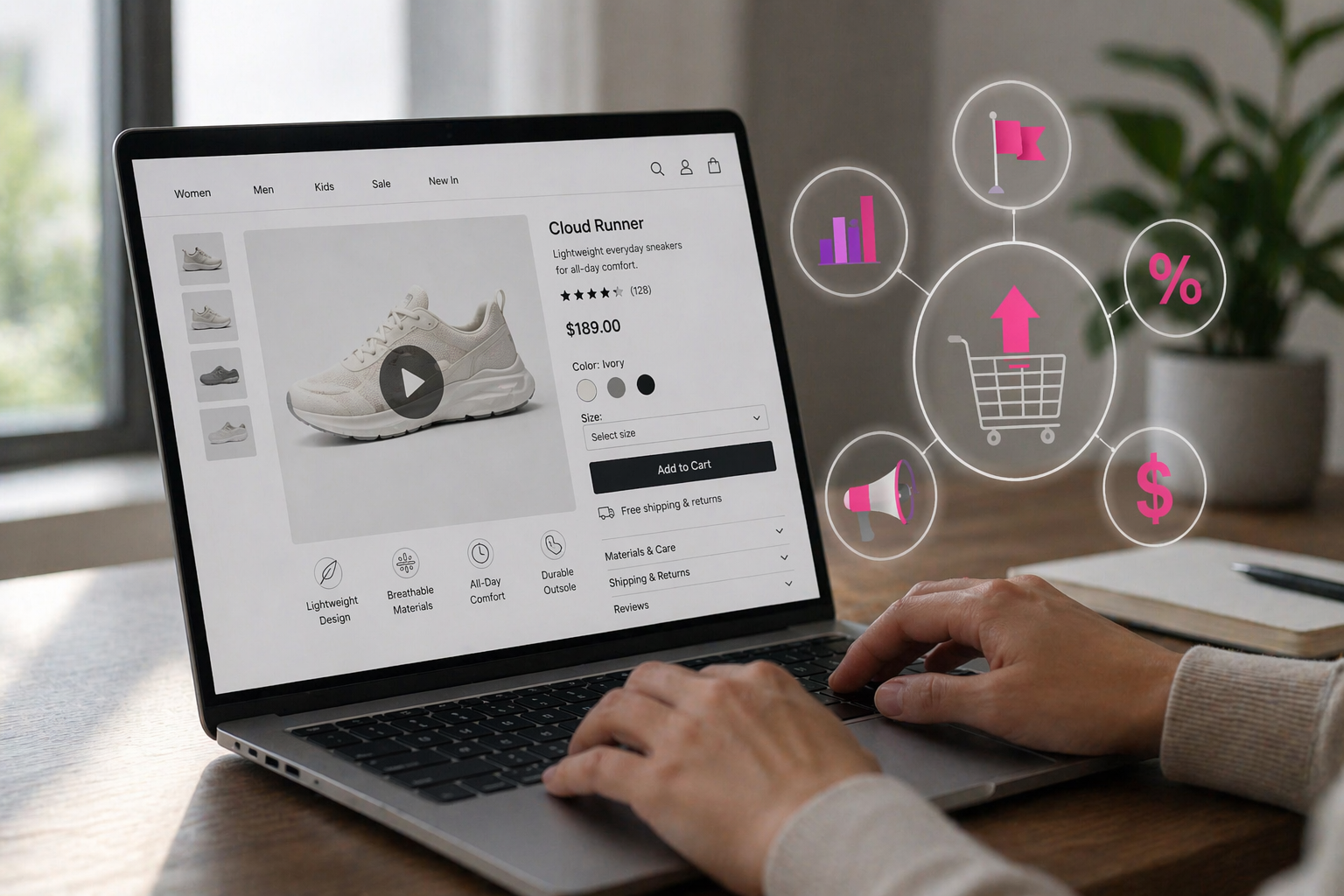
Brands that clearly explain why prices are rising through detailed product pages, cost breakdowns, and clear messaging are better positioned to preserve trust and loyalty, even when prices go up. That insight, from Akeneo's research cited in Glossy, points to something most brands underweight: the product page is now a trust-building surface, not just a transaction surface.
A shopper considering a $220 skincare set that cost $175 eighteen months ago is not asking whether she wants it. She already knows she does. She is asking whether it is worth $220. That question does not get answered by a price justification email or a banner ad. It gets answered on the PDP, at the moment she is evaluating the product.
The conversion lever at this moment is not discounting. Discounting trains the customer to wait. It also further erodes the margins that tariffs are already compressing. The lever is confidence, helping the shopper justify the price she is already considering paying, with content that shows the product in use, addresses her specific questions, and removes the uncertainty that causes her to hesitate.
The Acquisition Problem Is a Conversion Opportunity
Brands that have throttled paid acquisition in response to margin pressure are, often without realizing it, improving the average intent level of their remaining traffic. The shoppers arriving organically, through email, through search, and through social discovery are more likely to be in genuine purchase mode than the marginal traffic that paid campaigns were buying.
This is the counterintuitive opportunity inside the tariff squeeze: the conversion improvement potential on high-intent organic traffic is higher now than it was when paid volume was masking conversion inefficiency.
Under Armour cited tariffs as the primary driver of a 310 basis point gross margin decline to 44.4%. At that margin compression level, the math on paid acquisition gets punishing quickly. A brand running at 44% gross margin that is also paying $18 to acquire a customer who converts once at $80 is operating at a structural loss before CAC. Fixing conversion on existing traffic does not require incremental spend. It requires better content, better answers, and a PDP that is built for the shopper who arrives with intent.
What the High-Intent Shopper Needs Right Now
The tariff-era shopper is not less motivated to buy. Overall holiday spending remained steady, but shoppers are more deliberate about what qualifies as a "worth it" purchase in a tariff-affected market. That deliberateness shows up as more research before purchase, more questions at the point of decision, and lower tolerance for PDPs that do not immediately communicate value.
Three things consistently move the needle for this shopper:
Video that demonstrates value, not just product. A shopper considering a higher-priced item needs to see it in use, understand its quality at a sensory level, and feel the purchase is justified. A thirty-second video showing a skincare product's texture, a kitchen appliance's performance, or a jacket's construction communicates what no specification sheet can. It does not just inform, it builds conviction.
Real-time answers to questions that used to be dealbreakers. The question a shopper cannot answer on the PDP is the question that sends her to Google, Reddit, or a competitor. In a price-sensitive environment, that exit is more permanent than it used to be. An AI shopping agent that answers product questions in real time, about ingredients, fit, compatibility, care, closes the confidence gap before it becomes a lost sale.
Content that scales across the full catalog. Tariff pressure is hitting brands unevenly across their SKU mix. The products under the most margin pressure are often the ones with the thinnest content coverage. A brand with 400 SKUs and video on its top 20 has a structural conversion disadvantage on the remaining 380. AI-generated content that covers the full catalog at scale is no longer a nice-to-have, it is the operational requirement for a tariff environment where every unconverted page visit represents a harder-to-replace dollar.
The Brands That Will Win This Period
The instinct to cut costs in response to margin pressure is understandable. It is also the move that compresses revenue alongside costs. Selective price increases are likely in 2026, but blanket price hikes won't work. Consumers are too informed and value-driven. Brands need to clearly tie any increase to something tangible: better quality, stronger materials, improved sourcing, or a better overall experience.
That "better overall experience" is not a vague aspiration. It is a specific digital requirement: a PDP that proves value in the moment a price-conscious shopper is deciding. Brands that invest in that experience right now, when acquisition is expensive and traffic is more intentional, are building a conversion infrastructure that will compound when the macro environment normalizes.
The brands that cut content investment alongside acquisition spend will emerge from this period with lower revenue, a weaker PDP infrastructure, and a harder rebuild. The brands that use this moment to optimize conversion on the traffic they have will come out leaner, sharper, and better positioned than they went in.
Talk to a Firework expert about building a conversion-first PDP strategy.
FAQ
How are tariffs affecting ecommerce brands in 2026? Tariffs are compressing gross margins across beauty, fashion, and consumer electronics by increasing landed costs on imported goods, raw materials, and packaging. Brands with heavy exposure to Chinese manufacturing are facing the sharpest impact, with some reporting 200 to 300 basis point margin headwinds. The downstream effect is higher consumer prices, reduced paid acquisition budgets, and increased pressure on owned-channel conversion performance.
Should brands raise prices in response to tariffs? Selective price increases are more effective than blanket hikes. McKinsey's research indicates that brands tying price increases to demonstrable value, better materials, improved product experience, clearer product communication, retain more customer trust than those raising prices without explanation. 83% of consumers say they want clarity from brands on what is driving higher prices.
Why is conversion optimization more important than acquisition in a tariff environment? When gross margins compress, the cost of acquiring a new customer relative to the margin contribution of that sale deteriorates. Optimizing conversion on existing high-intent traffic improves revenue without incremental spend. Brands that shifted focus from paid acquisition to PDP quality in 2025 are better positioned heading into 2026 than those that maintained acquisition spend while cutting content investment.
What role does content play in converting price-conscious shoppers? Price-sensitive shoppers require more justification before committing. Video content that demonstrates product value, AI shopping agents that answer questions in real time, and rich PDP content that communicates quality reduce the uncertainty that causes hesitation. Brands with strong PDP content convert a higher percentage of the deliberate, research-driven shoppers that tariff conditions are producing.
Which categories are most affected by tariffs in 2026? Consumer electronics face the highest duty exposure, with stacked tariffs pushing total duties above 150% on some categories. Fashion and apparel are significantly affected given that the US imports 89% of apparel sold domestically. Beauty faces sharp impacts on packaging materials including glass, aluminum, and specialty plastics. All three categories are Firework core verticals and are navigating the same underlying conversion challenge: higher prices require better content to convert.
Unlock Exclusive Insights
By submitting this form, you agree to Firework's privacy policy and consent to receive personalized marketing communications. You can unsubscribe at any time.