Mother's Day Ecommerce Statistics 2026: Spending, Trends, and What Shoppers Actually Buy
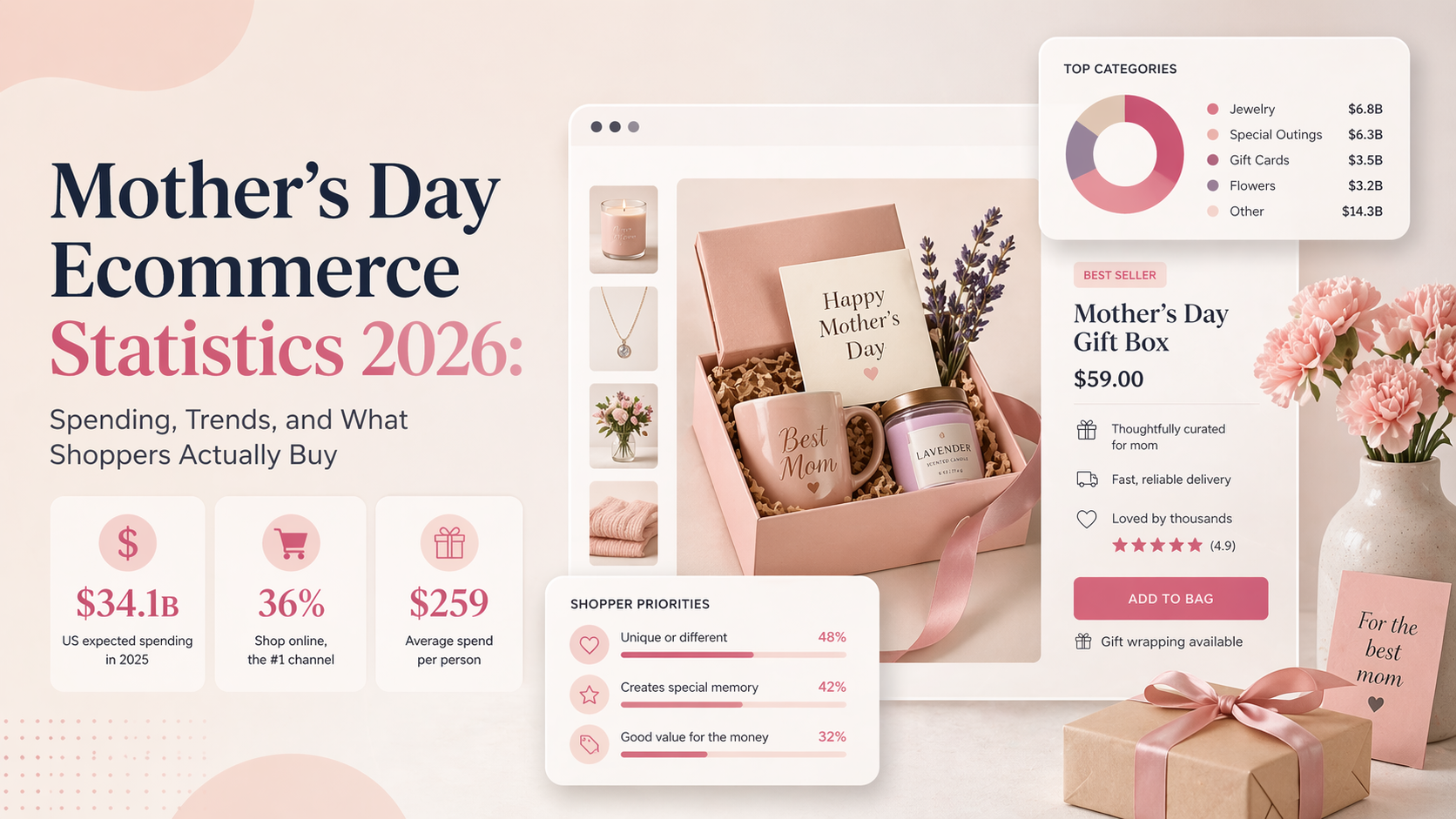

Mother's Day is the second largest retail spending event in the United States, trailing only the winter holidays. US consumers are expected to spend $34.1 billion celebrating the holiday in 2025, with online channels claiming the top spot as the preferred shopping destination for the first time. That shift is not a one-year anomaly, it reflects a durable change in how gift shoppers discover, evaluate, and purchase.
For brands in beauty, fashion, home, and consumer electronics, Mother's Day represents a concentrated window of high-intent, emotionally motivated buying behavior. The shopper is not browsing for herself. She is buying for someone else, which means the product needs to communicate its value quickly and clearly, the gifting context matters as much as the product itself, and content that shows the item in use drives more confidence than any description alone.
The statistics below cover total spending, category breakdowns, online channel performance, consumer behavior patterns, and the content signals that determine whether a gift shopper converts or keeps scrolling.
See how brands are converting gift shoppers with video and AI on their PDPs.
What Is Mother's Day Ecommerce?
Mother's Day ecommerce refers to the online purchase of gifts, experiences, and products given in celebration of mothers, stepmothers, grandmothers, and other maternal figures. It is one of the most concentrated gifting periods in retail, with the majority of purchases happening in a four-to-six week window before the second Sunday in May.
The category spans beauty and skincare, jewelry, apparel, home goods, flowers, gift cards, and experience-based gifts. It draws shoppers who are actively in decision mode, not passively browsing, which creates a higher-intent traffic profile than most non-seasonal ecommerce periods.
Mother's Day Spending Statistics
1. US consumers are expected to spend $34.1 billion on Mother's Day in 2025, up $600 million from 2024 (National Retail Federation and Prosper Insights & Analytics)
Mother's Day spending has grown consistently since 2018, including through the pandemic years. The 2025 figure represents a record second-highest spend in the survey's history. For brands planning seasonal campaigns, this trajectory confirms that consumer commitment to the holiday is structurally strong, even in periods of broader economic uncertainty.
2. 84% of US adults are expected to celebrate Mother's Day, with an average spend of $259.04 per person (National Retail Federation)
Participation rates have held remarkably stable. Four in five American adults celebrate the holiday, making it one of the widest-reach retail moments of the year. The average per-person spend of $259 puts it well above Valentine's Day and Easter in commercial significance, and the shopper profile, 57% buying for a mother or stepmother, 23% for a wife, skews toward considered, relationship-driven gifting rather than impulse buying.
3. The biggest Mother's Day spenders are adults aged 35 to 44, budgeting $345.75 on average (National Retail Federation)
This demographic represents the sweet spot for premium and experiential gifts. They are typically buying for a parent and potentially a spouse simultaneously, which drives higher total spend. For beauty, home, and lifestyle brands with products in the $80 to $200 range, this is the primary target audience for Mother's Day campaigns.
4. UK Mother's Day retail spending is forecast to reach £18 billion in 2026, representing 15% year-on-year growth (Savvy, survey of 1,000 UK shoppers)
The UK celebrates Mothering Sunday in mid-March, creating a separate spending peak from the US May date. The 15% growth rate signals strong momentum, with premiumisation a clear theme: 56% of UK shoppers expected to spend more on Mother's Day than on a typical gift occasion, and beauty and jewellery were both flagged as outperforming categories.
5. Mother's Day is the third most popular holiday in the US, behind only Christmas and the Fourth of July (Medill Spiegel Research Center, based on NRF data)
This ranking matters for content planning. Brands that treat Mother's Day as a secondary event are underinvesting in one of the three highest-participation retail moments of the year. The holiday's emotional stakes, buying for a mother, grandmother, or wife rather than oneself, drive higher average order values and lower price sensitivity than most other seasonal periods.
Category Spending Statistics
6. Jewelry leads all Mother's Day gift categories at $6.8 billion in total spend (National Retail Federation)
Jewelry has ranked first in total category spend for eight consecutive years. It is a high-AOV, emotionally resonant gift category that benefits significantly from video content, a piece of jewelry shown being worn, in natural light, in motion, communicates far more than a studio flat lay. Brands in adjacent categories like beauty and home should note that the shopper spending at this level is already primed for premium gifting.
7. Special outings account for $6.3 billion in Mother's Day spending, with 61% of celebrants planning a dinner or experience (National Retail Federation)
Experience-based gifting has grown steadily post-pandemic. Gift card spending rose 7.3% and special outings spending rose 4.8% year over year in 2025. For product brands, this signals that the competition for Mother's Day wallet share is not just other physical gift categories, it is experiences, and brands that cannot communicate the emotional value of their product clearly will lose to a dinner reservation.
8. Gift cards account for $3.5 billion in Mother's Day spending, with spending up 7.3% year over year (National Retail Federation)
Gift card growth is a signal of shopper indecision, not category strength. When shoppers cannot find a product that feels right or specific enough, they default to a gift card. Brands that invest in clear, contextual product content, video demonstrations, gift guides, AI-assisted recommendations, reduce the likelihood of losing to a gift card by giving the shopper confidence in a specific product choice.
9. Flowers account for $3.2 billion in Mother's Day spend, though purchase intent has declined since 2023 (Medill Spiegel Research Center)
Traditional gifts remain dominant by volume, but their growth trajectory is softening. The shift is toward gifts that feel more personalized and lasting. For beauty, home, and lifestyle brands, this is an opportunity: products positioned as thoughtful, specific, and longer-lasting than flowers are gaining relative ground in the gifting consideration set.
Online Shopping and Channel Statistics
10. Online is the top Mother's Day shopping destination at 36%, ahead of department stores at 32% (National Retail Federation)
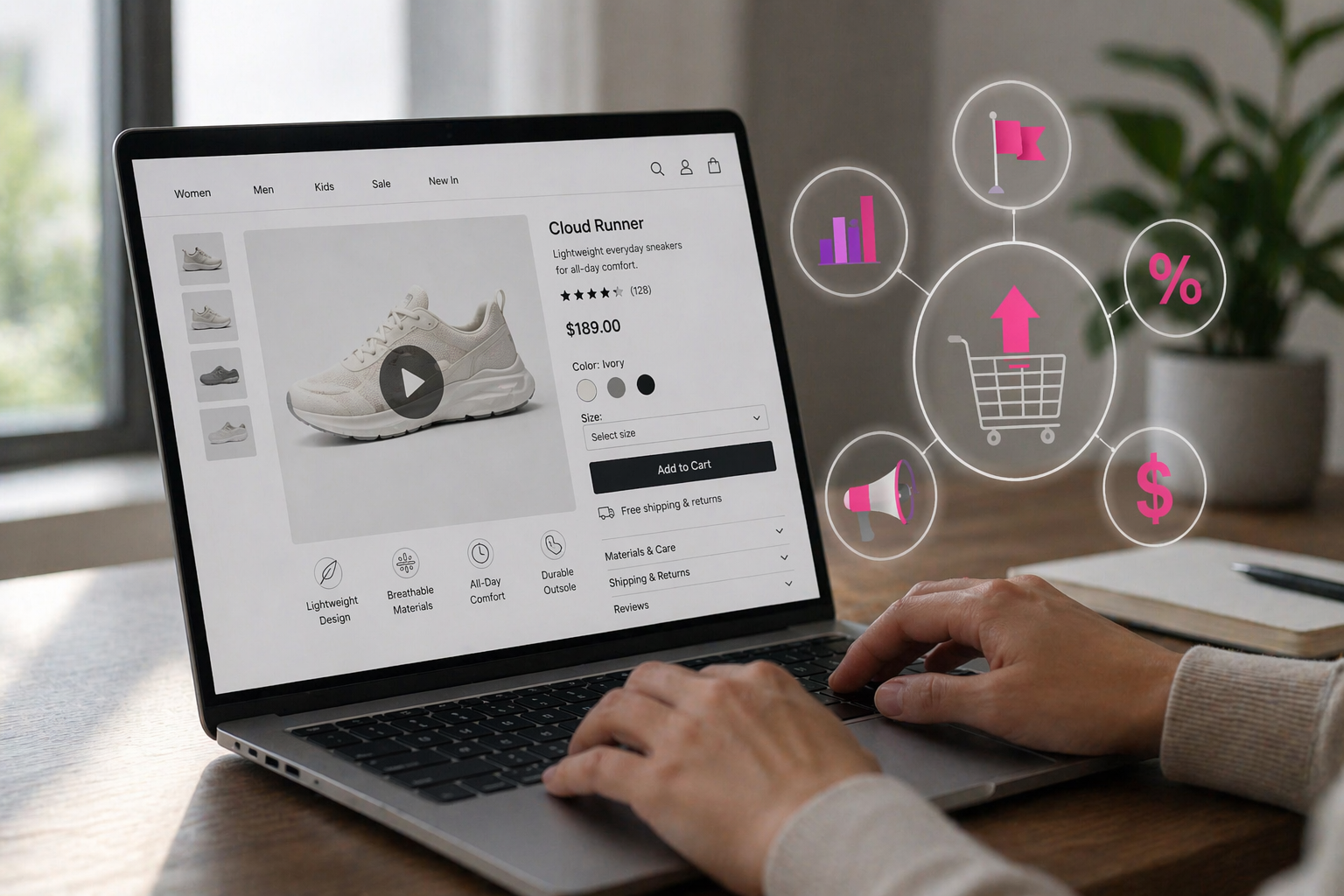
Online has overtaken every physical retail format as the preferred channel for Mother's Day gift purchases. For brands, this means the PDP is the primary gifting storefront. A product page that does not communicate gifting context, what it feels like to receive, how to present it, what makes it a thoughtful choice, is leaving conversion on the table during the highest-intent shopping window of the first half of the year.
11. 70% of Mother's Day shoppers plan their purchases at least two weeks in advance (Accio research)
Early planning behavior means the discovery window opens in late April and peaks in early May. Brands that have shoppable video content, gift guides, and AI-assisted recommendations live on their PDPs before the planning window opens are better positioned than those still preparing assets when intent peaks. The window is short and the competition for attention is high.
12. Over two-thirds of consumers look to the retailer for gift inspiration, with 33.9% doing so always or very often (Medill Spiegel Research Center)
This is the most underused insight in Mother's Day commerce. Shoppers want to be told what to buy, they are actively seeking guidance, not filtering through an unstructured catalog. Brands and retailers that create clear gifting narratives through curated collections, video-led gift guides, and AI-powered recommendations are meeting a stated consumer need. Those that present a standard PDP with no gifting context are not.
13. 52% of UK shoppers discovered Mother's Day gift ideas on social media, with short-form video influencing 34% of purchase decisions (Savvy, 2026)
Short-form video is now a primary discovery surface for Mother's Day gifting. Among shoppers with young children, 57% said short-form video content influenced their purchasing decisions. The implication for brands: video content produced for social discovery needs a direct path to purchase on the owned site, and the owned PDP needs to continue the video-first experience that started the journey.
Consumer Behavior Statistics
14. 48% of Mother's Day shoppers say finding a gift that is unique or different is their top priority, ahead of price or convenience (National Retail Federation)
Uniqueness outranks cost as a gifting criterion. This matters enormously for how brands position products during the Mother's Day window. A product framed as thoughtful, specific, and differentiated, with video content that shows the experience of receiving or using it, will convert better than the same product positioned on price. Gift shoppers are not bargain hunting; they are trying not to fail.
15. 42% of shoppers prioritize finding a gift that creates a special memory (National Retail Federation)
Memory and meaning rank above convenience and cost in gifting decisions. For beauty brands, this means positioning a skincare set as a ritual, not a product. For home brands, it means showing a moment, a morning routine, a calm space, not a spec sheet. The emotional job of a Mother's Day gift is to communicate care. Content that tells that story converts; content that lists features does not.
16. One in three UK shoppers plan to use an AI tool like ChatGPT or Gemini for Mother's Day gift ideas, rising to 60% among households with young children (Savvy, 2026)
AI-assisted gift discovery is arriving fast. When shoppers use AI tools to generate gift ideas, they arrive at brand sites with a specific product or category already in mind — higher intent, shorter consideration window. The brands whose products appear in AI-generated gift suggestions and whose PDPs can answer follow-up questions in real time will convert a disproportionate share of that traffic.
17. 58% of UK shoppers expected to buy a customized or personalized gift for Mother's Day 2026 (Savvy, 2026)
Personalization demand in gifting is accelerating. Nearly six in ten shoppers sought customized products, which signals a significant opportunity for brands that offer personalization options and communicate them clearly. It also raises the bar for what a product page needs to do: shoppers who want something customized will abandon quickly if the customization path is unclear or requires navigating away from the product.
What Mother's Day Statistics Mean for Ecommerce Brands
The data points to three consistent themes that separate high-converting Mother's Day performers from the rest.
Gifting context belongs on the PDP. The shopper arriving at a product page during the Mother's Day window is not shopping for herself, she is trying to solve a gifting problem under an emotional deadline. Product pages that communicate why this gift is meaningful, how it will be received, and what makes it different convert better than standard PDPs during this period. Video content showing the product as a gift, unboxing, in use, as part of a moment, closes the confidence gap that gift shoppers feel.
The discovery-to-purchase path needs to be short. Over two-thirds of shoppers look to the retailer for inspiration, 52% find gifts on social media, and one in three are now using AI for gift ideas. Every one of those discovery paths ends at a brand's product page. If that page cannot close the sale quickly, with rich content, clear gifting positioning, and real-time answers to product questions, the sale migrates to a gift card or a competitor.
The window is short and intent is high. Mother's Day shoppers are not passive browsers. They arrive with a budget, a recipient in mind, and a deadline. Brands that have video content, AI shopping assistance, and clear gifting narratives live on their PDPs before the planning window opens will convert the peak traffic that arrives in the final two weeks.
Talk to a Firework expert about building a gifting-ready PDP experience.
FAQ
How much do Americans spend on Mother's Day? US consumers are expected to spend $34.1 billion on Mother's Day in 2025, averaging $259.04 per celebrating adult. The holiday ranks second only to the winter holidays in total consumer spending and has grown consistently since 2018. The biggest spenders are adults aged 35 to 44, who budget an average of $345.75.
What are the most popular Mother's Day gifts? Flowers remain the most commonly purchased gift at 74% of celebrants, followed by greeting cards at 73% and special outings at 61%. In total dollar terms, jewelry leads at $6.8 billion, followed by special outings at $6.3 billion and gift cards at $3.5 billion. Personalized gifts and experience-based presents are growing fastest among younger buyers.
Where do people shop for Mother's Day gifts online? Online is the top shopping channel for Mother's Day at 36% of shoppers, ahead of department stores at 32%. AI tools like ChatGPT are increasingly used for gift inspiration, particularly among younger households.
When do Mother's Day shoppers start buying? 70% of shoppers plan their Mother's Day purchases at least two weeks in advance, with the discovery window opening in late April. Brands that have gifting content and campaigns live before the planning window opens capture a larger share of consideration. Last-minute shopping in the final week before the holiday is also significant, driven by urgency and fast-delivery expectations.
Why does video content matter for Mother's Day ecommerce? Short-form video is a primary gift discovery channel, with 34% of UK shoppers saying it influences their purchase decisions. Beyond discovery, video content on PDPs converts gift shoppers at higher rates because it communicates the emotional value of a gift, how it looks, feels, and will be received, more effectively than static imagery. Gift shoppers are not evaluating features; they are imagining the moment of giving.
Unlock Exclusive Insights
By submitting this form, you agree to Firework's privacy policy and consent to receive personalized marketing communications. You can unsubscribe at any time.