Whoever Controls the AI Agent Controls the Customer. Brands Need to Own Their Version.


Etsy, Target, and Walmart all made the same move in early 2026. They put their product catalogs inside ChatGPT and Gemini, making their merchandise available for discovery and purchase through external AI platforms. The rationale was straightforward: meet customers where they are. If shoppers are starting their purchase journeys inside AI tools, retailers should be there too.
The rationale is defensible. The trade-off is not being discussed enough.
When a customer shops through an external AI agent, the retailer gets the transaction. The AI platform gets everything else: the search query, the comparison behavior, the questions asked, the hesitations, the final decision signal. That behavioral data is the raw material for every future personalization, every recommendation, every retention strategy a brand might want to run. It does not flow back to the retailer. It stays with whoever controls the agent.
"Whoever controls the agents now has the power," Kartik Hosanagar, a marketing professor at the Wharton School, told Retail Dive. That is not a speculative claim about the future. It is a description of what is already happening.
What Brands Are Trading Away
The data a brand collects from its own site is qualitatively different from a transaction record. When a shopper lands on a product page directly, a brand can observe what they searched for to get there, which products they clicked, how long they spent on each one, which images they zoomed into, what they added to cart and then removed, and what question they typed into a search bar before leaving without buying. Each of those signals is a data point about intent, uncertainty, and preference that a brand can act on to improve future experiences.
AI-driven US ecommerce traffic grew 758% year over year during the 2025 holiday season, according to Adobe's Holiday Shopping report. That growth means the share of shopping journeys starting inside AI platforms is increasing rapidly. Every journey that starts and ends inside ChatGPT or Gemini is a journey that generates zero first-party data for the brand whose product was sold.
Deloitte's 2026 Retail Industry Global Outlook found that 81% of surveyed retail executives believe generative AI will weaken brand loyalty by 2027. The mechanism is not hard to trace. When a shopper buys a product through an AI agent that compares it against three alternatives and selects it on price and availability, they do not have a brand relationship. They have a transaction. The next time they need the same product, they will ask the AI agent again, and the agent will compare again. Brand preference does not survive that loop.
The Disintermediation Pattern Is Familiar
Retail has been through this before. When brands moved their products onto Amazon in the early 2010s, the argument was the same: meet customers where they are. Many did, and many grew revenue in the short term. What they also did was hand Amazon their customer relationships, their pricing visibility, their review data, and eventually their competitive intelligence. The brands that relied most heavily on Amazon found themselves with strong sales and weak brand equity, unable to communicate directly with their own buyers.
The external AI platform dynamic follows the same structure. The platform controls the interface, the conversation, and the data. The brand supplies the inventory. The customer relationship belongs to whoever owns the agent.
Walmart's incoming CEO John Furner emphasized the sentiment at NRF, framing the move to external AI platforms as meeting customers where they are. That framing is accurate as far as it goes. What it does not account for is what happens to the customer relationship once the agent decides where to send them next time.
The Owned AI Case
The alternative is not to ignore AI commerce. Shoppers are already using AI tools to discover, compare, and evaluate products, and that behavior is not reversing. The question is whether a brand's AI presence exists only on third-party platforms or also on its own site.
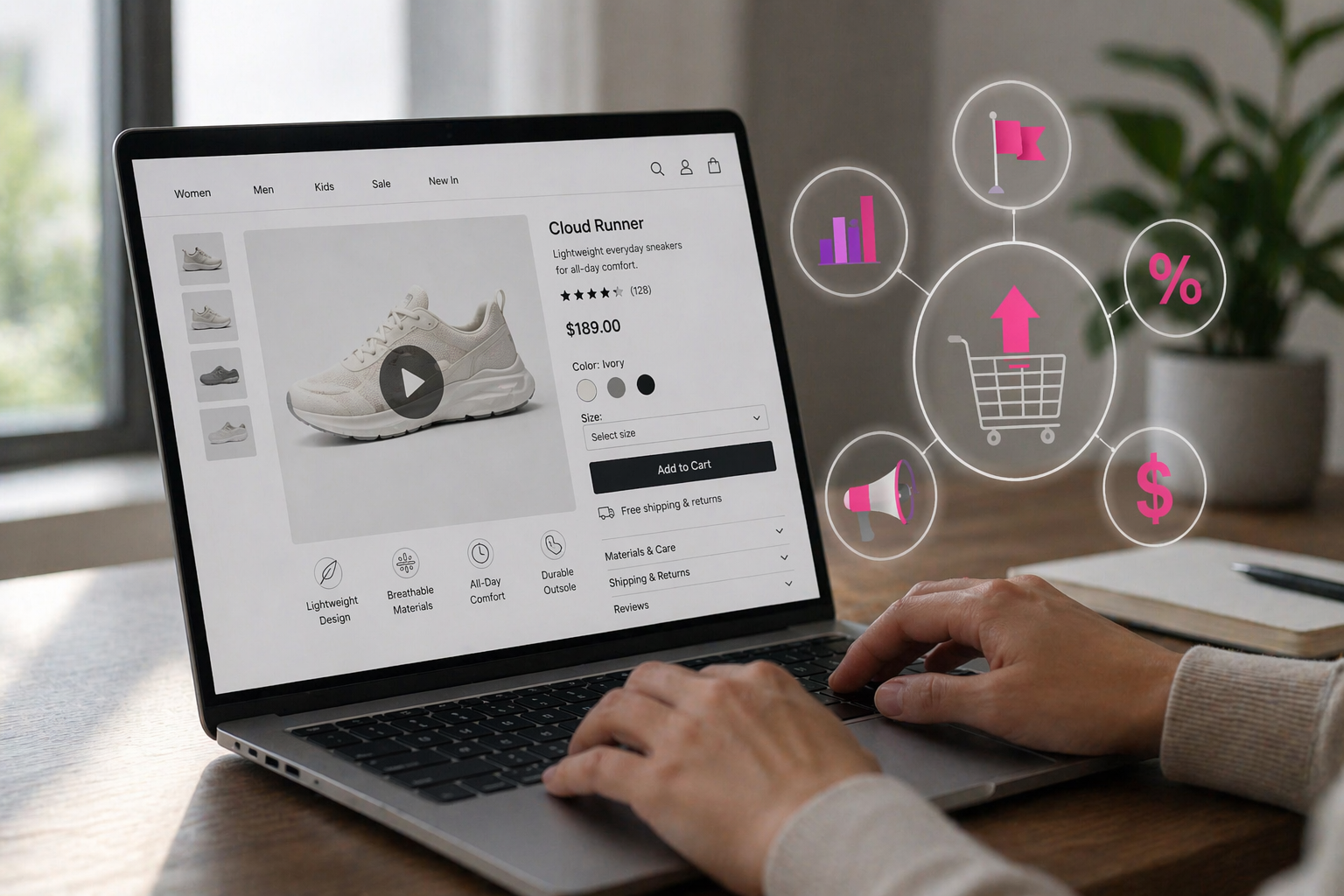
An AI shopping agent deployed on a brand's own PDP operates within the brand's environment, on the brand's terms, generating behavioral data that belongs to the brand. Every question a shopper asks, every product they consider, every hesitation they express is a signal that feeds back into the brand's understanding of its own customers.
Shopify reported that orders from AI-powered searches grew 15x year over year through 2025. The brands capturing that growth on their own sites are building a data asset and a customer relationship simultaneously. The brands capturing it only through external platforms are building neither.
The owned AI agent also solves a problem that external platforms create: the confidence gap at the point of decision. A shopper who arrives at a brand's product page after being referred by ChatGPT is a high-intent shopper. They have already done research. They have a specific question or a near-final decision. The job of the owned PDP at that moment is to close the gap between intent and purchase, not to route them back out to a third-party interface.
An AI agent trained on a brand's own product knowledge, its specifications, its sizing guides, its ingredient lists, its compatibility information, its return policies, can answer that question in the moment they ask it. A third-party agent operating from a product feed cannot.
The Data Flywheel Only Works on Owned Channels
There is a compounding dynamic that makes the owned AI investment more valuable over time than the third-party distribution play. Every interaction a shopper has with an owned AI agent generates intent data. That data improves the agent's ability to answer future questions. Better answers improve conversion. Higher conversion generates more interactions. More interactions generate more data. The flywheel only runs if the data flows back to the brand.
On a third-party platform, the flywheel runs for the platform. The AI gets smarter about how to sell products. The brand gets a sales report.
Retail leaders have identified that brands which make themselves easily discoverable and scannable by AI systems will be the true winners of 2026. That discoverability argument applies to third-party platforms, but the winning condition is not just being found. It is being found and owning what happens next.
Brands that invest in third-party AI distribution without building a parallel owned AI capability are making a bet that discovery is the whole game. The conversion data, the retention data, and the loyalty behavior say otherwise.
What This Means for Brand Strategy in 2026
The brands best positioned right now are the ones treating owned AI as infrastructure, not a feature. They are building AI agents trained on their own product knowledge, deployed on their own PDPs, generating behavioral data they can act on. They are also visible on external AI platforms, because that is where discovery increasingly happens. But they are not confusing distribution with relationships.
The practical question for any brand evaluating its AI commerce strategy is simple: when a shopper interacts with an AI agent while considering your product, who learns from that interaction? If the answer is anyone other than you, that is the problem to solve.
Talk to a Firework expert about deploying an AI agent on your PDPs.
FAQ
Why is owning an AI shopping agent strategically important for brands in 2026? When shoppers interact with a brand's AI agent on an owned site, every behavioral signal, questions asked, products compared, hesitations expressed, generates first-party data that belongs to the brand. On third-party AI platforms, that data stays with the platform. As AI-driven commerce grows, the brands that own their AI interactions will build increasingly precise customer intelligence. Those that rely solely on external platforms will generate transactions without relationships.
What is the risk of selling through external AI platforms like ChatGPT or Gemini? The primary risks are data loss and brand disintermediation. When a customer completes a purchase through an external AI agent, the retailer receives the transaction but the platform retains the behavioral data: what the shopper searched for, how they compared options, what questions they asked, and what ultimately drove their decision. Deloitte's 2026 Retail Outlook found 81% of retail executives believe generative AI will weaken brand loyalty by 2027, in part because AI-mediated purchases do not build direct brand relationships.
How does an owned AI agent differ from a third-party AI platform? An owned AI agent operates on a brand's site, trained on that brand's proprietary product knowledge, and generates behavioral data that flows back to the brand. A third-party agent operates on an external platform using a product feed, generates data for the platform, and cannot provide the brand-specific depth of knowledge that closes high-consideration sales. The owned agent converts the high-intent shopper. The third-party agent refers to them.
What first-party data does an owned AI shopping agent generate? An owned AI agent captures intent signals that no other tool can: the specific questions shoppers ask at the point of decision, the product attributes they are uncertain about, the comparisons they make between SKUs, the language they use to describe their needs, and the answers that move them from consideration to purchase. This data is qualitatively richer than page view or click data because it reflects active purchase intent, not passive browsing.
Should brands stop distributing products on external AI platforms? No. External AI platforms are legitimate discovery surfaces and brands should be visible on them. The strategic error is treating third-party distribution as a substitute for owned AI capability rather than a complement to it. The winning position is presence on external platforms for discovery and a superior owned experience for conversion, with an AI agent on the brand's own PDP capturing the behavioral data that makes every future interaction smarter.
Unlock Exclusive Insights
By submitting this form, you agree to Firework's privacy policy and consent to receive personalized marketing communications. You can unsubscribe at any time.