How to Calculate the ROI of an AI Shopping Agent Before You Buy

Most enterprise buying decisions for AI shopping agents start with a demo and end with a question nobody answers cleanly: what will this actually return?
Vendors quote conversion lifts. Analysts cite market projections. Neither of those is a business case. Before you sign a contract, you need a number you can defend to a CFO, and a framework for building it with the data you already have.
This post gives you that framework.
Why Most ROI Estimates for AI Shopping Agents Are Wrong
The numbers circulating in the market are real, but they are not your numbers.
Industry research shows AI-engaged shoppers convert at roughly 4x the rate of shoppers who do not interact with AI chat. Retail chatbots have been tied to sales increases of up to 67% in some deployments.
These figures are true in aggregate. They are also built on wildly different baselines: different traffic volumes, different average order values, different product complexity, different existing conversion rates. A $40M DTC brand and a $2B omnichannel retailer will see very different outcomes from the same technology.
The only ROI number that matters is yours. Here is how to calculate it.
Step 1: Establish Your Current Conversion Baseline
Pull these numbers from your analytics before any vendor conversation:
- Site-wide conversion rate (sessions to orders)
- PDP conversion rate specifically — this is where AI shopping agents have the most direct impact
- Average order value (AOV)
- Monthly unique sessions to the pages you plan to deploy the agent on
- Cart abandonment rate
Most enterprise brands run a site-wide conversion rate between 2.5% and 3.5%, with PDPs often lower depending on product complexity. If you are below 2%, an AI shopping agent addresses one real cause: shoppers who had questions and left because no one answered them.
Step 2: Model the Conversion Lift Conservatively
Resist the temptation to use the high end of published benchmarks. A conservative model builds trust with finance and leaves room to exceed expectations.
A reasonable working range for an AI shopping agent deployed on product pages:
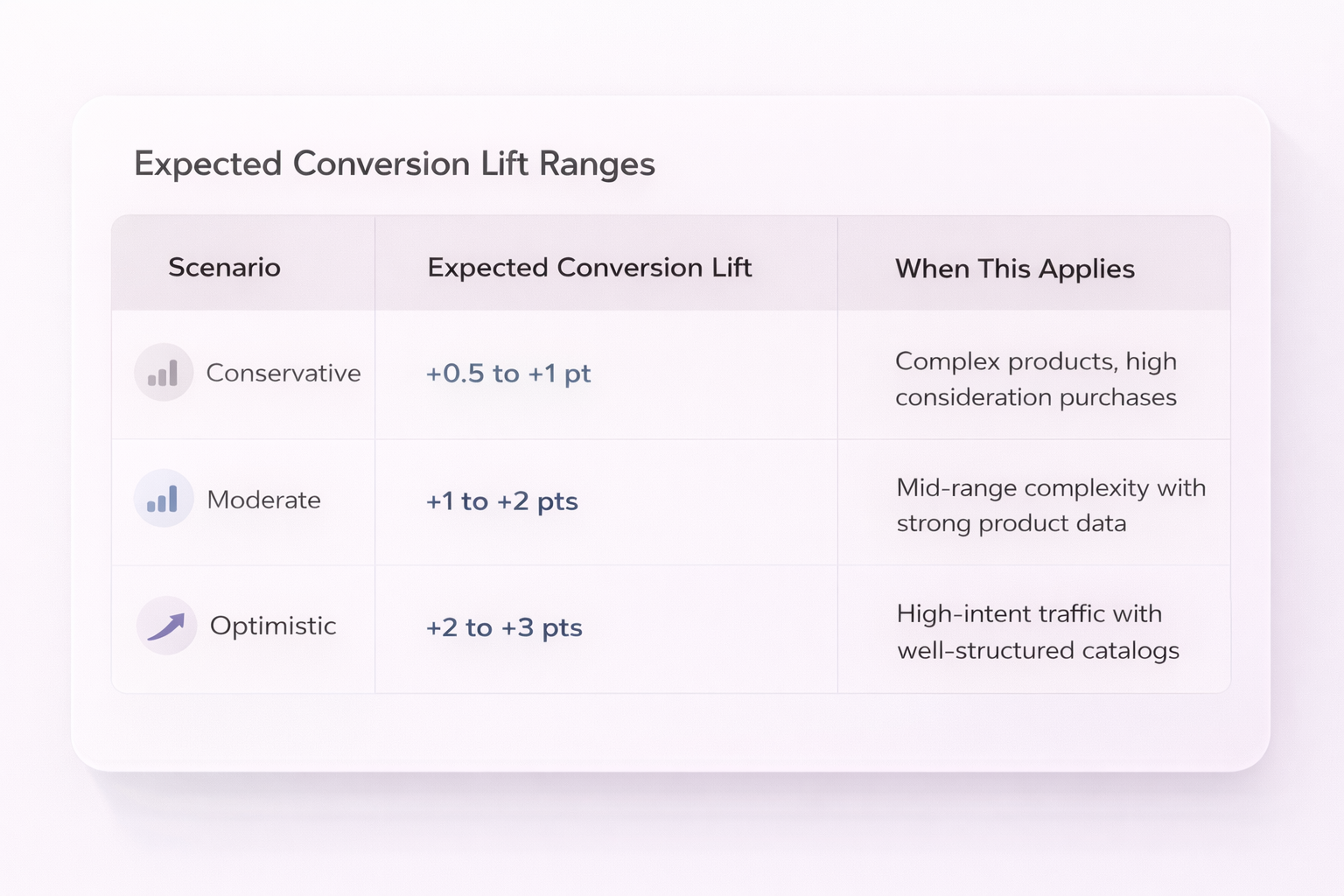
The math:
Monthly sessions × lift in conversion rate × AOV = incremental monthly revenue
Example (moderate scenario):
500,000 sessions/month × 1.5% lift = 7,500 additional orders
7,500 orders × $120 AOV = $900,000 incremental monthly revenue
Run this at your actual numbers. The lift percentage is the variable to sense-check with your vendor, not accept at face value.
Step 3: Account for AOV Impact
An AI shopping agent does not just convert more shoppers. It changes what they buy.
When a shopper gets a direct answer to "which of these two products is right for my situation," they buy with more confidence. They are also more likely to add complementary items when recommended in context.
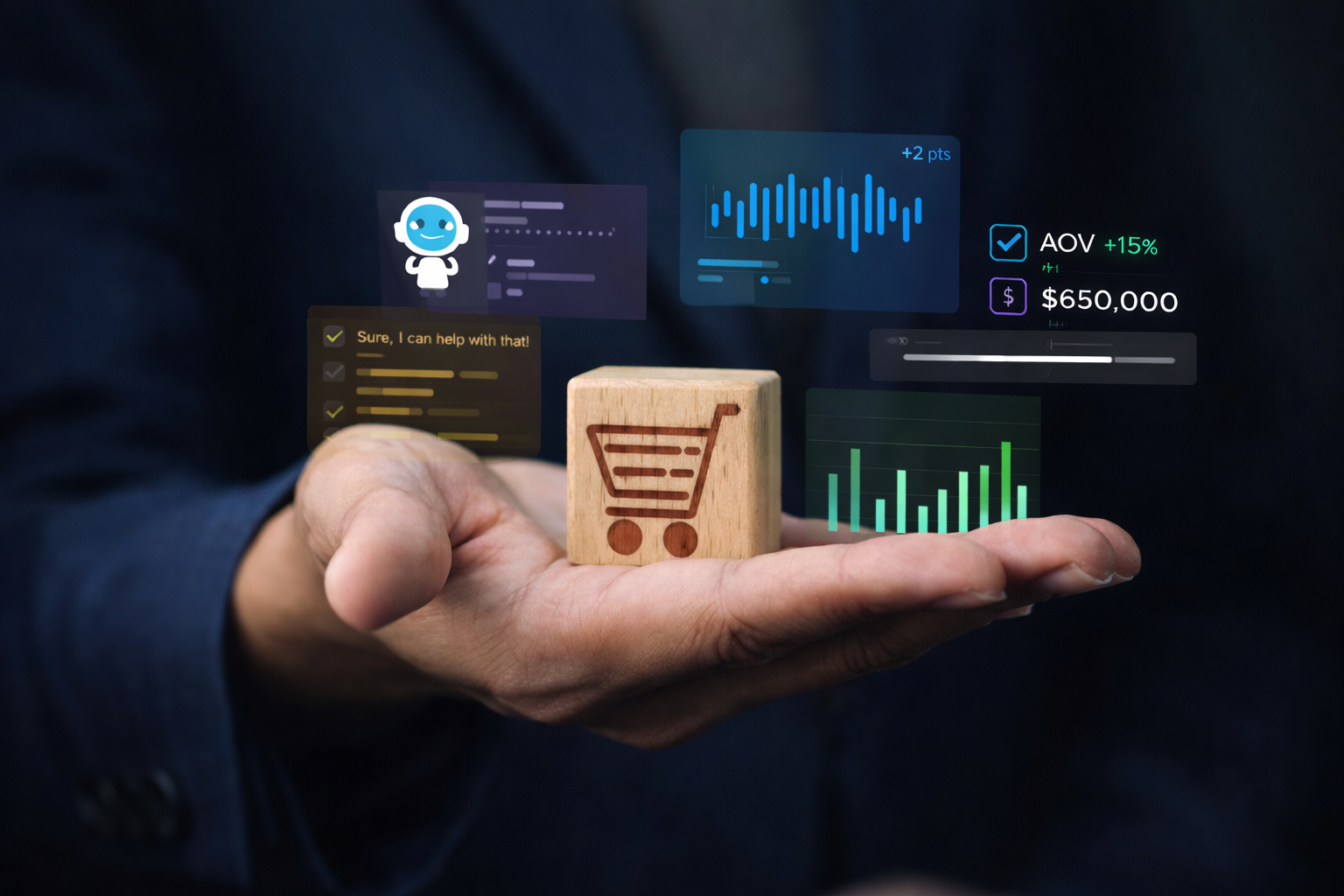
AI-powered upsell and cross-sell recommendations can increase AOV by 15 to 25% in well-implemented deployments. Apply a conservative 10% AOV lift to your calculation as a separate line item, or exclude it entirely and treat any AOV improvement as upside.
Step 4: Factor in Deflected Support Costs
This is the line item most ecommerce teams forget to include, and it is often what tips an ROI model into an easy approval.
If your support team handles pre-purchase questions, calculate:
- Average cost per support ticket (labor + tooling)
- Volume of pre-purchase questions per month (look at chat logs and email queues)
- Estimated deflection rate from AI (typically 30 to 60% for product questions)
Example:
2,000 pre-purchase support tickets/month × $8 average cost = $16,000/month
50% deflection = $8,000/month in support savings
Add this to your revenue model. For brands with large support operations, this figure alone can justify the investment.
Step 5: Estimate Implementation and Ongoing Costs
A real ROI calculation requires both sides of the equation. Get clear answers from vendors on:
- Implementation fee (one-time or amortized over contract)
- Monthly or annual licensing
- Integration costs — connecting the agent to your product catalog, inventory feed, and CMS
- Internal resource time — who owns this after go-live, and how many hours per month
Ask vendors specifically what is included in onboarding and what requires your engineering team. The gap between quoted and real implementation cost is where deals go sideways post-signature.
Step 6: Calculate Payback Period
With revenue impact and cost structure in hand, the payback calculation is straightforward:
Total investment (implementation + first year licensing) ÷ monthly incremental revenue = months to payback
For most enterprise deployments, the data suggests an average payback period of around nine months for AI-enabled solutions broadly. For AI shopping agents deployed on high-traffic PDPs specifically, the payback window tends to be shorter because the revenue impact is immediate and attributable.
If a vendor cannot give you a clear answer on what a realistic payback period looks like at your traffic volume and AOV, that is a signal, not a buying objection.
What to Ask Before You Sign
An ROI framework is only useful if you can pressure-test it with data. Ask:
- What is the average conversion lift you see in deployments with similar traffic volume and product complexity to ours?
- How long does implementation typically take, and what is required from our engineering team?
- How is the agent's performance measured and reported after go-live?
- What happens to the model as our product catalog changes?
- Can you show us a customer in our vertical with a similar baseline who has been live for at least six months?
That last question separates vendors with proof from vendors with projections.
How Firework Approaches This
Firework's AI Shopping Agent is built for exactly the scenario this framework is designed to model: high-consideration products where shoppers have questions that a static PDP cannot answer.
The agent sits directly on product pages, answers questions about specific SKUs from your catalog, and guides shoppers to a purchase decision without sending them to a competitor search result or a support queue.
When evaluating Firework alongside any other vendor, apply this same framework. The numbers should hold up. If they do not, that conversation is worth having before you are locked into a contract.
Ready to run the numbers on your actual traffic? Book a demo and walk through the calculation with Firework's team using your data.
FAQ
How do you calculate the ROI of an AI shopping agent?
ROI is calculated by estimating incremental revenue from conversion rate improvements, adding any increase in average order value, and factoring in cost savings from reduced support volume. This total impact is then compared against implementation and licensing costs to determine payback period.
What is a typical conversion lift from an AI shopping agent?
Most enterprise deployments see a conversion lift between +0.5 and +3 percentage points, depending on product complexity, traffic quality, and how optimized the product page experience is.
How quickly does an AI shopping agent pay for itself?
Payback periods typically range from a few months to under a year. High-traffic sites with strong intent signals often see faster returns because the impact on conversion is immediate.
Does an AI shopping agent increase average order value?
Yes. By answering product questions and recommending complementary items in context, AI shopping agents can increase AOV, often in the range of 10–25% depending on implementation.
Unlock Exclusive Insights
By submitting this form, you agree to Firework's privacy policy and consent to receive personalized marketing communications. You can unsubscribe at any time.