The Agentic Commerce Readiness Checklist for Enterprise Brands

Ecommerce is entering a new phase. As product catalogs grow more complex and shopper expectations continue to rise, traditional digital experiences are starting to fall short. Static product pages and keyword-based search no longer meet the needs of customers who expect faster, more intuitive, and more personalized shopping journeys.
This shift is driving the emergence of agentic commerce where AI-powered systems actively guide shoppers through product discovery, evaluation, and decision-making.
But for enterprise brands, adopting agentic commerce isn’t simply about implementing new technology. It requires a clear understanding of whether the current ecommerce experience, data infrastructure, and operational workflows are ready to support it.
What Is Agentic Commerce?
Agentic commerce refers to ecommerce experiences where intelligent systems assist shoppers in real time, helping them discover products, answer questions, and make confident purchase decisions.
Instead of requiring shoppers to navigate complex product pages on their own, AI introduces a layer of guidance within the experience.
This represents a shift from:
- self-directed browsing
to - guided discovery
Why Readiness Matters for Enterprise Brands
Enterprise ecommerce environments are inherently complex.
Brands often operate across:
- multiple regions and languages
- large and dynamic product catalogs
- layered technology stacks
- multiple customer touchpoints
Introducing AI into this environment without proper preparation can create friction instead of value.
Agentic commerce performs best when it builds on a strong foundation, one where product data, content, and customer experience are already aligned.
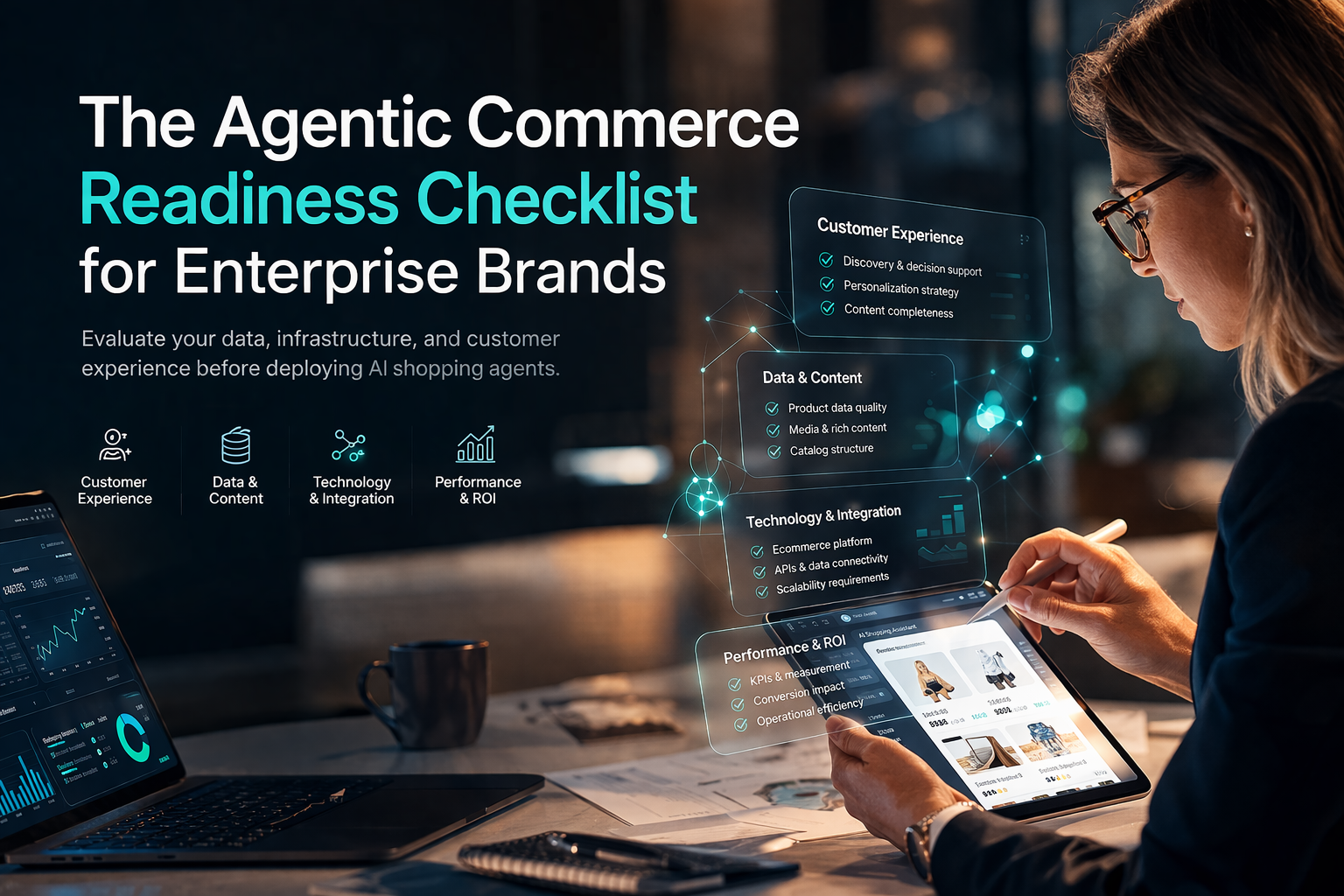
The Agentic Commerce Readiness Checklist
Before deploying AI shopping agents or conversational product experiences, enterprise teams should evaluate readiness across five key areas.
1. Product Discovery Experience
Start with how shoppers currently discover and evaluate products.
Ask:
- Can shoppers easily find and compare products?
- Are product pages designed for exploration or just information delivery?
- Do customers leave your site to research elsewhere?
If shoppers rely on external sources to make decisions, it signals a gap in the on-site experience. Agentic commerce is most impactful when it enhances discovery within the product page itself.
2. Product Data and Content Quality
AI-powered experiences depend on structured, reliable product data.
Evaluate:
- Are product descriptions detailed and consistent?
- Is your product data structured and accessible across systems?
- Do you have visual or video content that supports product understanding?
AI is only as effective as the data it can access. Gaps in product content limit its ability to provide meaningful guidance.
3. Ecommerce Infrastructure and Integration
Enterprise brands must ensure AI solutions integrate smoothly into existing systems.
Consider:
- Can your platform support dynamic, interactive product experiences?
- Is your product catalog accessible in real time?
- How easily can new technologies integrate into your current stack?
The most effective AI implementations enhance your infrastructure, they don’t require replacing it.
4. Customer Experience Strategy
AI should align with your broader experience strategy.
Ask:
- What role should AI play in the shopping journey?
- Should it guide discovery, answer questions, or both?
- How should it reflect your brand voice and tone?
The most effective implementations feel like a natural extension of the brand, not an add-on feature.
5. Measurement and Performance Readiness
Enterprise teams need clear frameworks for measuring success.
Define:
- What metrics will indicate success? (engagement, conversion, return rates)
- How will AI impact product discovery and decision-making?
- Can interactions be tracked and optimized over time?
Without clear measurement, it’s difficult to understand the impact of agentic commerce initiatives.
From Reactive Search to Proactive Guidance
Traditional ecommerce experiences rely on a reactive model.
Shoppers are expected to search, filter, and navigate product pages on their own, often asking:
“What do I need to know?”
This approach places the burden of discovery entirely on the shopper.
Agentic commerce shifts this dynamic.
Instead of waiting for input, AI-powered product page agents anticipate shopper intent and guide the experience forward, delivering:
“Here’s what matters for your decision.”
This transition reduces friction at the most critical moment in the journey: the point of decision.
What This Looks Like in Practice
Modern AI product page agents act as intelligent shopping companions embedded directly within the product experience.
Rather than simply responding to questions, they proactively support the shopper by:
- surfacing relevant information in real time
- suggesting helpful next questions or comparisons
- providing contextual explanations (including video and visual content)
- anticipating shopper needs based on behavior and context
This transforms the product page from a static destination into a guided decision environment.
Learn how AI shopping agents enable guided product discovery.
Why This Matters for Enterprise Brands
For enterprise ecommerce teams, this shift directly addresses long-standing challenges:
- Reducing research drop-off
Shoppers no longer need to leave the site to find answers - Improving purchase confidence
AI helps clarify product details and reduce uncertainty - Scaling product expertise
Every shopper receives consistent, real-time guidance - Supporting complex catalogs
Especially critical in categories with technical or high-consideration products
By proactively guiding the shopper, AI helps bridge the gap between information and decision.
From Readiness to Implementation
Agentic commerce is a shift in how ecommerce experiences are designed. The goal is not just to introduce AI, but to create more intuitive, guided shopping journeys that align with how customers actually make decisions.
Enterprise brands that invest in readiness today will be better positioned to implement AI effectively and scale those experiences across their digital ecosystem.
Key Takeaways for Enterprise Teams
Agentic commerce requires alignment across experience, data, and infrastructure.
To prepare, brands should focus on:
- strengthening product discovery experiences
- improving product data quality
- ensuring integration readiness
- aligning AI with customer experience strategy
- defining clear performance metrics
As ecommerce continues to evolve, the brands that succeed will be those that move beyond static experiences and design intelligent, guided shopping environments.
Explore AI-Powered Product Page Experiences
See how AI shopping agents transform product pages into guided, conversational experiences that support confident purchase decisions.
Unlock Exclusive Insights
By submitting this form, you agree to Firework's privacy policy and consent to receive personalized marketing communications. You can unsubscribe at any time.