
What Is Shoppable Video? The Complete Guide for Ecommerce Brands (2026)


A shoppable video is a video format that embeds clickable product links directly inside the player, allowing viewers to explore products, add items to cart, and complete a purchase without leaving the video. Unlike traditional product video, which drives awareness but requires the shopper to navigate elsewhere to buy, shoppable video closes the gap between content and conversion in a single interaction.
It is also referred to as interactive video, video commerce, or, in the context of AI-generated formats, AIGC (AI-generated content for ecommerce).
How Shoppable Video Works
The mechanics are straightforward, but the architecture behind them varies significantly across platforms.
- A video is created or uploaded. This can be brand-produced content, user-generated content (UGC) from social channels, a live stream, or AI-generated product video built from a product feed.
- Products are tagged inside the player. Clickable hotspots, overlays, or embedded product cards are layered onto the video, linked to specific SKUs in the brand's catalog.
- The video is deployed to the relevant surface. This could be a product detail page (PDP), a homepage, a collection page, an email, or a social platform.
- The shopper interacts. When a viewer sees a product they want, they tap or click the tag. Product details, pricing, and an add-to-cart option appear without the shopper leaving the video or navigating to a separate page.
- The purchase is completed inline. The transaction is processed within the video experience. The brand captures the sale, the behavioral data, and the customer relationship.
The most important variable in step 3 is where the video lives. Shoppable video deployed on owned properties, brand websites and apps, captures first-party behavioral data. Shoppable video that runs exclusively on third-party social platforms leaves that data, and the customer relationship, with the platform.
Types of Shoppable Video
Not all shoppable video is the same format. The three primary types each serve a different role in a commerce strategy.
Pre-Recorded Shoppable Video
The foundational format. A video is filmed, edited, tagged with product links, and published to a surface, typically a PDP, homepage, or collection page. This format works well for product demonstrations, how-to content, lookbooks, and UGC from social channels repurposed for on-site use. It is evergreen: once published, it continues driving conversion without additional production effort.
Live Shopping
A scheduled or always-on live video broadcast where products are presented in real time and viewers can purchase directly during the stream. Event-based live shopping uses scheduled human-hosted broadcasts. AI-hosted always-on streaming runs continuously across product categories without scheduling constraints or per-stream production overhead. Both formats can feature interactive elements including real-time Q&A, polls, and product carousels.
AI-Generated Product Video (AIGC)
The newest and fastest-growing format. AI generates product videos directly from a brand's product feed, catalog data, and performance signals without a camera, studio, or production team. The output is PDP-ready video that addresses specific shopper objections identified through signal mining, deployed at scale across thousands of SKUs. This is the format that makes video commerce operationally viable for enterprise catalogs where traditional production costs prohibit coverage at scale.
Why Shoppable Video Performs Better Than Static Pages
The performance gap between product pages with shoppable video and those without is well-documented and consistent across categories.
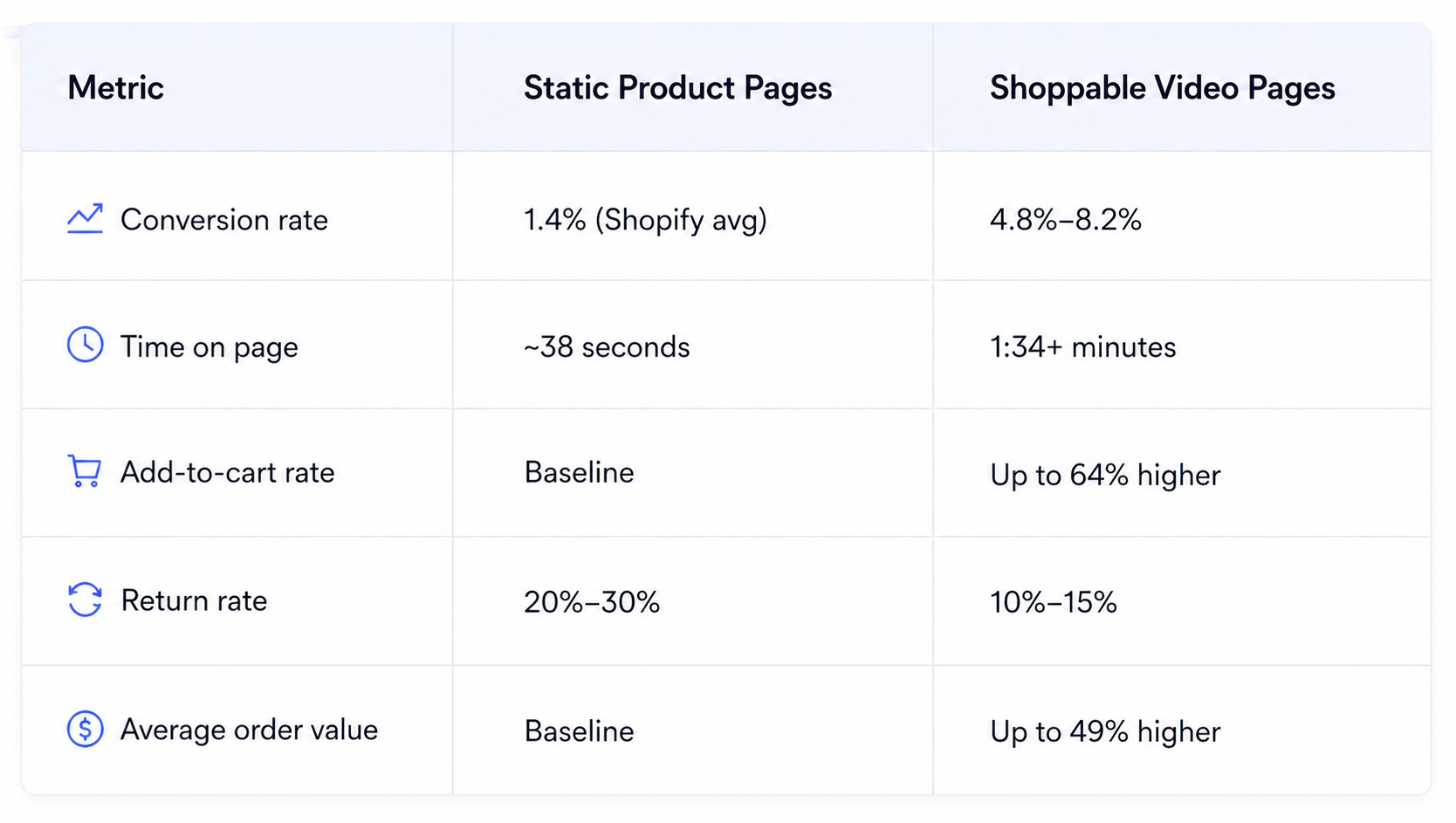
Sources: ReelTok, Shopify / Littledata benchmark data, eStreamly, benovel.com
The underlying reason is not that video is inherently more persuasive than images. It is that video resolves the specific objections that prevent purchase on static pages. For apparel, on-model video showing real movement resolves fit uncertainty better than multiple static photos. For skincare, application technique and result demonstration are the primary conversion levers. For electronics and home goods, feature demonstration and real-use context address durability and compatibility concerns that text descriptions leave open.
Products with video convert at 86% higher rates than those without, average order values increase 30% when customers watch product videos, and return rates drop 40% because video sets accurate expectations. That return rate reduction is one of the most undervalued benefits in the category: lower returns reduce operational cost and improve net margin, not just top-line revenue.
Shoppable Video ROI: What Brands Are Seeing
Performance data from brands that have deployed shoppable video at scale tells a consistent story.
Brands implementing shoppable video are seeing conversion rate lifts of 5–26%, average order value increases up to 49%, and millions in attributed revenue.
At enterprise scale, the numbers compound. One anonymized enterprise deployment using AI-generated product video contributed $3.36M in GMV in a single month, at a 4.3% video conversion rate. Another achieved 5x the engagement rate of human-hosted content through AI-hosted streaming.
The caveat worth stating clearly: results vary significantly by category, placement, and implementation quality. A poorly placed video on a slow-loading page will underperform a well-optimized static page. The quality of the video content, the specificity of the product tagging, and the deployment surface all affect outcomes. These benchmarks represent well-executed implementations, not averages across all deployments.
How to Get Started With Shoppable Video
The right starting point depends on catalog size and existing content assets.
For brands with existing video content: Start by auditing what you already have. UGC from social channels, brand videos, product demos, and campaign content can often be repurposed as shoppable video with product tagging added. Most platforms allow existing video files to be imported and tagged without re-shooting. This is the fastest path to deployment and often generates meaningful performance data before any new production investment.
For brands building from scratch: Prioritize your highest-traffic, highest-return-rate product pages first. These are the PDPs where video is most likely to move a measurable needle on both revenue and operational cost. Start with a small set of products, measure performance against a control group (pages without video), and use that data to build the internal business case for broader deployment.
For brands with large catalogs: Traditional production economics make per-SKU video coverage impractical at scale. A catalog of 10,000 SKUs at traditional production costs ($5,000–$30,000 per video) represents a budget that no ecommerce team has available. AI-generated product video solves this: video is created directly from the product feed and catalog data, deployed across thousands of PDPs, and iterated based on performance signals, without a production team involved in each individual asset.
When evaluating any shoppable video platform, ask five questions before committing:
- Does it deploy directly to product pages, or does it just produce a video file?
- Does it integrate with your ecommerce platform (Shopify, Salesforce Commerce Cloud, SAP, etc.)?
- What is the site speed impact? Ask for Core Web Vitals field data from an enterprise deployment.
- Does it capture first-party behavioral data on your owned properties?
- Can it scale across your full catalog without per-video production overhead?
Shoppable Video and First-Party Data
Over 95% of product detail pages lack rich media. That is not a creative gap, it is a data gap. Every shopper who lands on a static PDP and leaves without purchasing takes their behavioral signals with them. Shoppable video captures those signals: which products were engaged with, where viewers dropped off, what questions were asked, what objections prevented purchase.
For enterprise brands building owned customer intelligence, particularly those reducing dependency on third-party cookies and paid social platforms, the data architecture underneath a shoppable video deployment matters as much as the conversion rate it drives. On-site, first-party shoppable video generates a compounding data asset with every deployment. Social-first shoppable video generates reach, but the data stays with the platform.
This is why the most strategically valuable shoppable video deployments are on owned properties, not rented channels. Owned-channel performance can be measured, attributed, and iterated on. Rented-channel performance is subject to algorithm changes, platform policies, and data access that the brand does not control.
Firework's video commerce platform covers all three shoppable video formats: pre-recorded, live shopping, and AI-generated product video in a single deployment. See how it works.
FAQ’s
What is the difference between shoppable video and live shopping? Shoppable video is typically pre-recorded or AI-generated content with embedded product links, available on demand at any time. Live shopping is a real-time broadcast format, either human-hosted or AI-hosted, where viewers watch and purchase during an active stream. Both are formats within the broader category of video commerce. Most mature brands deploy both: shoppable video for persistent on-site product discovery, live shopping for scheduled moments like product launches or seasonal campaigns.
Does shoppable video work on Shopify? Yes. Most shoppable video platforms integrate directly with Shopify via app or API, allowing video to be embedded on PDPs, collection pages, and homepages with product tagging linked to the Shopify catalog. Some platforms also sync with the Shopify Shop app feed and TikTok Shop. When evaluating Shopify-specific platforms, confirm that the embed is lightweight enough to preserve Core Web Vitals scores, particularly LCP on mobile, where most Shopify traffic originates.
How much does shoppable video cost? It depends on the format and platform. Traditional video production costs range from $5,000 to $30,000 per video in the US market. UGC-style production is lower but still requires talent, coordination, and editing. AI-generated product video costs roughly $35 to $150 per video including PDP deployment, representing a 97 to 99% cost reduction versus traditional production. Platform licensing fees vary; most enterprise platforms charge monthly or annual SaaS fees in addition to production costs.
What is shoppable video ROI? ROI depends on the baseline you are measuring against. Common metrics used to evaluate shoppable video ROI include video-attributed GMV, conversion rate lift on video-enabled PDPs versus control pages, add-to-cart rate improvement, return rate reduction, and time on page. Enterprise brands tracking video-attributed GMV directly often report payback periods under 90 days at meaningful deployment scale. The most reliable approach is to run a controlled A/B test, video versus no video, on a matched set of PDPs before scaling.
Is shoppable video the same as interactive video? The terms are related but not identical. Interactive video is a broad category that includes any video format with clickable or responsive elements such as polls, quizzes, branching narratives, and hotspots. Shoppable video is specifically interactive video where the interactive elements are tied to product purchase. All shoppable video is interactive video; not all interactive video is shoppable.
Does shoppable video work for large product catalogs? Traditional shoppable video production does not scale economically beyond a few hundred SKUs. AI-generated product video is specifically designed for large catalog coverage: video is generated directly from the product feed across thousands of SKUs simultaneously, without per-video production effort. For enterprise brands with catalogs of 1,000 or more SKUs, AI-generated video is the only format that makes full-catalog video coverage financially viable.
What types of products benefit most from shoppable video? Categories where shopper uncertainty is highest before purchase include apparel (fit, movement, scale), beauty and skincare (application, results, texture), home goods (size in context, materials), electronics (feature demonstration, setup), and food and grocery (preparation, portion, freshness). These are also the categories with the highest return rates, which means video drives both conversion improvement and operational cost reduction simultaneously.
Unlock Exclusive Insights
By submitting this form, you agree to Firework's privacy policy and consent to receive personalized marketing communications. You can unsubscribe at any time.












.png)
